Thursday, March 24, 2011

Orchestras Feeding America: Harrisburg, March 2011

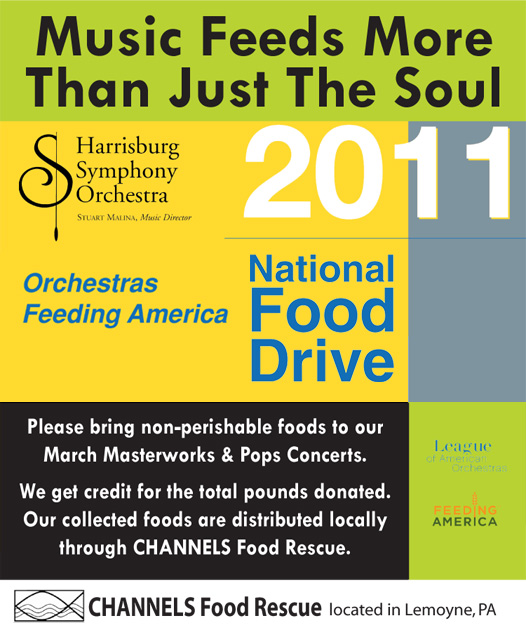
This weekend's concerts with the Harrisburg Symphony are part of the League of American Orchestra's national drive, "Orchestras Feeding America."

Please consider bringing non-perishable food items to the Forum for Saturday night's or Sunday afternoon's concert.

Donate to the cause: help support the Harrisburg Symphony supporting this national food drive.

- - - - -

Had you read the book or seen the film, "The Soloist"? Then you know what inspired this drive.

There are probably few free-lance musicians I've known - myself included - who haven't at one time or another had nightmares about something like this: I'm sure the Forum stage is filled with talented musicians who feel very close to this, whether they make their living full-time as a free-lancer or hold down a day job that supports their choice to make music for you.

Dreams don't quite come true, despite the training, the talent; the gigs don't pay enough the make a living, pay the rent, put food on the table; governments cutting support for the arts don't take into account the human toll for those people who are the artists in our community, bringing a very important contribution to the table that helps identify who we are as a society, help make our lives more fulfilling.

And in today's economy, how many people do you know - from your friends, neighbors, those schoolmates you wonder "where are they now," perhaps even yourself - who have not had these same fears or concerns, no matter what their profession?

Think about this:

In 2008, 49.1 million Americans lived in food insecure households, 32.4 million adults and 16.7 million children.

In 2008, 17.1 million households were food insecure, increased from the 13 million households in 2007.

In 2008, households with children reported food insecurity at almost double the rate for those without children, 21 percent compared to 11.3 percent.

In 2008, 2.3 million households with seniors were food insecure.

Feeding America provides emergency food assistance to approximately 4.5 million different people in any given week.

Please consider bringing non-perishable food items with you to the Forum for Saturday night's concert at 8pm or Sunday afternoon's concert at 3pm.

And then listen to music Bach composed for the good citizens of Leipzig, hanging out in Zimmermann's Coffee Shop listening to him conduct his 3rd Orchestral Suite (especially its famous 'Air') with the Collegium Musicum, the town's closest thing to an orchestra in a public concert hall - yes, even before it was fashionable to play in 'alternative venues' and before there was Starbucks, Bach was playing in coffee shops!

And music of Beethoven who once was arrested as a vagrant by the Viennese police because of the way he was dressed, a man we normally think of as a Titan Among Men, writing this sublime music but who, during the years he was writing his 8th Symphony, was having trouble making ends meet because the aristocratic patrons who were supporting him financially were unable to make their contributions due to the failure in the economy after the French army took over Vienna.

You can find out more about the concert - which includes the orchestra's principal violist, Julius Wirth, playing a viola concerto by the Czech composer, Zdenek Lukas - by listening to the podcast of the recent conversation Stuart Malina and I had.

Read more about Beethoven and his 8th Symphony in these posts:
Getting Behind the Music
Life Behind the Music
That Old Odd/Even Conundrum: Listening to Beethoven's Symphonies

- Dick Strawser

Wednesday, March 23, 2011

Beethoven's 8th Symphony: Getting Behind the Music

Beethoven conducted the first public performance of his 7th and 8th Symphonies in 1814. Stuart Malina conducts the 8th Symphony this weekend with the Harrisburg Symphony, part of the Masterworks program that also includes Bach's 3rd Orchestral Suite, Ives' "Unanswered Question" and a viola concerto by Czech composer Zdenek Lukas with the principal violist of the orchestra, Julius Wirth.

The performances are Saturday at 8pm and Sunday at 3pm at the Forum in downtown Harrisburg.

You can hear the conversation I had with Stuart about the concert in this podcast (the link takes you to his website - click on the 'podcast' link under the post title).

(Don't forget, this weekend's concerts are part of the nationwide drive "Feeding America," sponsored by the League of American Orchestras. Please bring non-perishable food items to the Forum for either concert. For more information, click here.)

- - - - -

Beethoven’s Symphony No. 8 is often overlooked in the sequence of his nine symphonies even though Beethoven himself had a special fondness for it (calling it "my little one") and preferring it to the 7th.

(You can read more details – or at least my thoughts on the matter – in a parallel post at my other blog, Thoughts on a Train, here.)

Since we normally think of a composer finishing one work before moving on to the next, I’d like to point out that Beethoven was a highly accomplished multi-tasker, writing several works if not concurrently, at least working out certain details simultaneously, often making great use of that back burner.

Look at the dates of all nine symphonies – not just when they were completed or premiered, but when they started showing up in his sketch books:

Symphony No. 1 in C: 1794 or 1795 to 1800
Symphony No. 2 in D: 1801-1802
Symphony No. 3 in E-flat (“Eroica”): 1802-1804
Symphony No. 4 in B-flat: around 1804 (while working on Fidelio) to 1806
Symphony No. 5 in C Minor: sketches between 1800-1804, begun in 1804 and completed in 1808

So far, everything looks fairly continuous, finishing one symphony before going on to the next. But it still goes against the conception that there were two years between symphonies while he concentrated on other works.


Keep in mind that between 1802 and 1804, in addition to the “Eroica,” Beethoven was also working on the opera Fidelio, the “Waldstein,” “Appasionata” and “Kreutzer” Sonatas – but also, during this time, sketching material that would eventually be part of the 5th Symphony which he put aside on a number of occasions in order to complete the 4th Symphony as well as Fidelio, the three Razumovsky Quartets, the 4th Piano Concerto, the Violin Concerto and the Mass in C.

Eventually he completed the 5th while working on the 6th which were then premiered together at the same concert. Some of the 5th's sketches go back to the notebooks of 1800. Though most of the work was done between 1804 and 1808, the first two movements were largely complete by 1805 when he put it aside to compose the 4th. So, by some quirk of Fate (pun intended), for whatever reasons he chose to put the C Minor aside rather than wait to begin the new B-flat Symphony, the most epic of Beethoven’s heroic symphonies almost became an even-numbered symphony.

Symphony No. 6 in F (“Pastoral”): sketches appear as early as 1803, written between 1806-1808
Symphony No. 7 in A: sketches in 1809, completed 1812 (some sources say April, others “Summer”)
Symphony No. 8 in F: sketches in 1809, written between completion of 7th and August or October, 1812
Symphony No. 9 in D Minor (“Choral”): sketches in 1815 & 1817 (including an idea for another symphony in B-flat), then 1822-23 (first three movements complete), last movement finished in 1824.
Symphony “No. 10” in E-flat (left unfinished): fragments of ideas unrealized, found within the sketchbooks for the 9th (1822-24) – at one point, Beethoven mentioned the 9th would be an instrumental symphony, the “Ode to Joy” a separate cantata, but the 10th would end with a choral movement)

While Mozart and Schubert were spontaneous composers who sometimes seemed to write things down as fast as they heard them in their head (part of Mozart’s creative process, apparently, was to work things out in his head even before he put pen to paper), Beethoven struggled with new works over a long gestation period, as can be seem from the dates between some of the earliest sketches and the date of completion.

It’s unlikely, if he waited until he’d completed the 7th, Beethoven might have composed the 8th in a month or even four months as is usually stated. If he wasn’t actively working on it, the fact there were sketches for ideas made concurrently with the 7th – ideas that did not fit into that particular work – it’s very likely this new symphony was gestating similarly to the way he composed the 5th and the 6th, two remarkably contrasting works.

Therefore the 8th is to the 7th as the 6th is to the 5th – and presumably as the 10th might have been to the 9th. (Barry Cooper’s controversial realization of the 10th’s sketches are so disappointing by comparison, we have to remember that an unfinished 9th symphony realized from sketches before 1822 would have become a very different composition.)

Ironically, Beethoven was setting up his own odd/even conundrum.

If anything, Beethoven not only compartmentalized his creativity, working of contrasting works simultaneously, he compartmentalized his life from his creativity. While we could say the 5th is “about” his personal struggle with his deafness, the music manages to transcend that to a universal level that can be appreciated as the struggles of an archetypal hero or perceived as the listener’s own struggles with adversity, some immediate crisis that, through Beethoven’s music, we might find inspiration to overcome.

(This is essentially the way we interpret Tchaikovsky’s 4th, 5th and 6th Symphonies, except the hero doesn’t always win. You can read more about his three “Fate” Symphonies here, here and here.)

The 7th is often described as a public work, easy to access and appreciate (uncomplicated). The 8th is considered more abstract without the dance-like enthusiasms heard in its companion. Perhaps, as a more “aristocratic” or “courtly” work, it comes off as a throw-back to Haydn’s era, therefore old-fashioned, nostalgic. Yet there are many parallels between them: the joyful smiles of both opening themes (once past the 7th’s slow introduction), the rhythmic pulse of the 2nd movements, the dance of the 3rd movements or the humor and exuberance of the finales.

Except in the 8th, it’s not as overt – again, perhaps more subdued by comparison, a citified person as opposed to one letting his hair down in the countryside, but both having a good time.

There is a stronger differentiation between the 2nd movements mostly because the 7th’s is in the minor mode and, at the tempo it’s usually taken, comes off like a funeral march. But the 7th’s is marked “Allegretto” and the 8th’s “Allegretto scherzando,” instead of the traditional slow movement, marked “andante” or “adagio.” (Andante is a leisurely walking tempo, but Adagio is slow – Lento, even slower. But Allegretto is not as slow as Andante but not as fast as Allegro, a fast, more lively tempo, the traditional tempo for a symphony’s first movement.)

Both “slow” movements are fueled by a pulse – in the 7th, by the steady quarter and two eighth notes, then two quarter notes, like a march – bummm bum-bum bumm bumm ; in the 8th, the bup-bup-bup-bup in the winds are 16th notes but pervade the texture much in the same way the 7th’s march-like rhythm underpins everything.

Whatever Beethoven may have intended (if anything) in his 2nd movements, the steady pulse in the 8th’s comes originally from a humorous canon he’d jotted down as a joking tribute to Johann Nepomuk Mälzel, the inventor of a metronome-like device that helped musicians systematize tempos. This was, however, only Mälzel’s latest invention to cross Beethoven’s path: earlier, in 1808, he invented an “ear trumpet” which Beethoven tried to help overcome his deafness; for something called a “panharmonicon” which was a kind of musical juke-box, a contraption that could imitate the sounds of an orchestra, Beethoven originally conceived his “Battle of Vittoria” (eventually known as “Wellington’s Victory”), reworking it for orchestra when the mechanical device proved to be less than adequate. Mälzel also invented a mechanical chess-player, but that’s another story…

The 7th is propelled by its rhythms – many of the “themes” grow out of nothing more than repeated notes in a given rhythm. The 8th is more tuneful in the traditional sense – for instance, the not-quite-a-minuet (the old-fashioned 3rd movement before Beethoven replaced it with a scherzo or “joke”) compared to the wild country dance of the 7th.

Rhythm is a driving force behind the finales, as well. The 7th's may be more like “composing under the influence” compared to the 8th’s (see below), but there are still unexpected turns (the sudden changes in dynamic, the sound of the timpani playing in octaves – interesting sound when you consider Beethoven was probably too deaf to appreciate it – and the overall genial humor).

But the finale of the 8th is fascinating for another reason. So far, this symphony is very short compared to the rest of them and this at a time when Beethoven was working towards elongating the forms he was using.

Traditionally, the “sonata form” that forms the basis of sonatas and symphonies was in three parts – the Exposition (where, as a student of mine once said, “the composer exposes himself” – or rather, states the movement’s main themes), the Development (where these ideas are taken and ‘developed’ or expanded or dissected and discussed – like a debate, the exposition might be the statement of the topic, the development becomes the “argument”) and then the Recapitulation (where these ideas are put back together again, rounding off the discussion with resolution).

To the exposition, a composer could add more themes or more transitional material between themes. To make sure the listener was well aware of the materials, this exposition was usually marked to be repeated. In the development (which in some composers is often brief, almost perfunctory; in others, the meat of the movement), a composer can just keep spinning out this material, creating more drama and more tension before it resolves into the recapitulation. But after this “recap,” composers started adding a “coda” (literally, “tail” in Italian) which extended the drama of the resolution. Haydn’s might be fairly brief but Beethoven turned them into “second development sections” where listeners might think “here we go again.”

In the 8th, it seems just when you think the movement is over, he begins a coda – and then when you think that’s over, there’s another section (or another coda) until, eventually, when you do reach the end, he gives you no less than 23 measures of final chords – the traditional V-I cadence, that dominant-to-tonic stamp that seals the final resolution, but here with not one final tonic chord but 15 of them! As if to say, “yes, it’s officially over! Really! Seriously! No, I’m not kidding, this time! That’s it! Done!”

Here is Tafelmusik (an early music group from Canada) conducted by Bruno Weil performing the last movement of Beethoven's Symphony No. 8.
- - - - -

- - - - -

And I haven’t even begun to get into what was going on in Beethoven’s life when he was writing this symphony!

Dick Strawser
Monday, March 21, 2011

March Masterworks: Revelations & Discoveries

The Masterworks Concert this weekend features Bach's 3rd Orchestral Suite and Beethoven's 8th Symphony along with the orchestra’s principal violist, Julius Wirth, playing a concerto probably no one in town has ever heard before by a composer, Zdenek Lukas, many here have probably never heard of. Also on the program is a short work by American composer, Charles Ives. To say it’s a “varied program” may be an understatement, so that was one of the first things conductor Stuart Malina and I addressed in our podcast about the program.

You can listen to it, here (follow the link, then click on ‘podcast’ underneath the post heading at Stuart’s blog).


The concert is Saturday evening at 8pm and Sunday afternoon at 3pm at the Forum in downtown Harrisburg. There's a pre-concert talk with Alexander Kahn, director of orchestral activities and bands at Gettysburg College, an hour before each performance - they're open to any ticket-holder for the concert.

And keep this in mind, if you would:
National Hunger Facts

In 2008, 49.1 million Americans lived in food insecure households, 32.4 million adults and 16.7 million children.

In 2008, 17.1 million households were food insecure, increased from the 13 million households in 2007.

In 2008, households with children reported food insecurity at almost double the rate for those without children, 21 percent compared to 11.3 percent.

In 2008, 2.3 million households with seniors were food insecure.

Feeding America provides emergency food assistance to approximately 4.5 million different people in any given week.

Please consider bringing some non-perishable food items along with you to leave with the ushers when you enter the Forum for the Harrisburg Symphony concerts this weekend, Saturday March 26th and Sunday March 27th.


- Dick Strawser

Stuart & Friends, March 23rd

A few hours before a rehearsal for this year’s “Stuart & Friends” concert, Stuart Malina took some time to chat about the concert you can attend Wednesday evening at 7:30 at the Rose Lehrman Center at Harrisburg Area Community College – in which Stuart joins friends and colleagues from the orchestra for an evening of chamber music.

There are three works on this year's concert – the suite, “Baal Shem” (Pictures of Hassidic Life) by Ernest Bloch; a piano trio by Beethoven, the one known as the “Ghost” Trio; and the Piano Quartet of Robert Schumann – in which Stuart will collaborate with concertmaster Odin Rathnam, principal 2nd Violinist Nicole Diaz, principal violist Julius Wirth and principal cellist Fiona Thompson.

Listen to the podcast, here (click on 'podcast' underneath the post heading on Stuart's blog).


(We also had a chance to talk about this weekend's Masterworks Concert - featuring Bach & Beethoven, a little Ives and what's probably an unfamiliar concerto by an unfamiliar composer played by Julius Wirth: you can listen to that podcast, here.)

Just a reminder, for those of you who are used to habit – usually, the “Stuart & Friends” program was scheduled the week after the March subscription concert but this year, it’s a few days before (in fact, the day before the first rehearsals for the weekend concert). In the past, they’ve been held at Whitaker Center in downtown Harrisburg, but this time it’ll be on the uptown campus of HACC at the Rose Lehrman Center – just so you’ve noticed that.

*** ***** ******** ***** ***

The Swiss-born composer Ernest Bloch started studying violin when he was 9 and later studied with one of the great violinists of the early 20th Century (if not of all time), Eugene Ysaÿe. He wrote his “Baal Shem – Three Pictures of Hassidic Life” in 1923, dedicated to the memory of his mother, originally for violin and piano while teaching in Cleveland, the year before he became an American citizen. He’d settled in the United States after 1916 (during the course of the First World War), moving to Cleveland in 1920 to become the first director of the Cleveland Institute of Music, before moving in 1925 to San Francisco for a similar position, then living in a small town on the Oregon coast from 1941 until his death in 1959.

Bloch is perhaps best known for works inspired by his Jewish heritage, particularly Schelomo, a musical meditation on the biblical King Solomon, and the underperformed “Avodat Ha-kodesh (Sacred Service),” a setting of the Sabbath morning liturgy, which he completed in 1934 as anti-Semitism in Europe continued to grow toward the Second World War.

The suite, Baal Shem, is in three movements – the first is a prayer, the second (the frequently performed “Nigun”) is an intense meditation, the emotional high point of the work, and the third movement is, by comparison, a light hearted dance which reminds us that Jewish Music does not always have to be on the edge of despair or the riddled with doubt.

It’s always difficult posting clips from YouTube to give you an example of what the piece sounds like – not just finding a good performance but one that can withstand various criticisms, one way or the other (nothing can ever be definitive) – but I thought I’d include these two: I admit to not knowing violinist Nachum Erlich but of many of the recordings (audio or video, whether a studio recording or captured on a cell-phone), I thought his performance of “Nigun” was intense enough (his mannerisms aside) to give you an idea, when many other performances lacked a comparable level of emotional involvement or only the occasional reference to satisfactory intonation. For me, frankly, in a piece like this, emotion trumps technical accuracy.


There are maybe hundreds of “Niguns” (for better or worse) to choose from on-line. Not so with the dance-like final movement, “Simchas Torah,” performed here by violinist Axel Strauss.


Beethoven’s “Ghost” Trio is a work that’s often overlooked (though I’ve heard a few live performances in recent years, this will be the second in the five weeks here in Harrisburg). The nickname comes from the spooky second movement and though I doubt it originated with Beethoven (the “Moonlight” Sonata was christened by a well-meaning critic who, on the other hand, could have focused on the last movement and called it the “Thunderstorm” Sonata, instead), the nickname is not only appropriate, it’s fairly close. The music for this movement came from sketches Beethoven originally made for an opera project that had recently been discarded, setting Shakespeare’s “Macbeth” - this excerpt originally for the scene with the Three Witches.

The outer movements, however, are pure abstract music. My favorite moment in the first movement is that unexpected note sustained in the cello even before the opening phrase is completed – Beethoven rushes everyone up the scale and then not only hits what seems like the wrong note (an F-natural instead of the expected F-sharp) which then seems like it’s going to resolve to a different key completely (and too soon) before – oh, okay – slipping up to F-sharp and doing what you’d expect it to do. This happens periodically throughout the piece and often tends to head off into other harmonic directions (perhaps a sly wink to his teacher Haydn, famous for such unexpectancies).

Here’s a performance with three young performers (at the time) – pianist Daniel Barenboim, violinist Pinchas Zukerman and cellist Jacqueline du Pre. Note the text that is included at the beginning of the video clip, recounting a reaction from the world premiere, when violinist (and composer) Ludwig Spohr (or Louis, as he often styled himself) heard Beethoven playing the piano:

‘It was not an enjoyable experience. First of all the piano was dreadfully out of tune, which did not trouble Beethoven in the least, since he could not hear it. Little or nothing remained of the brilliant technique which had been so much admired. In loud passages the poor deaf man hammered away at the notes crashing through whole groups of them so that without the score one lost all sense of the melody. I was deeply moved by the tragedy of it all. Beethoven's almost continual melancholy was no longer a mystery to me.’


Here’s the second movement – perhaps a bit “over-played” considering its Shakespearean inspiration – with Martha Argerich at the piano, violinist Renaud Capuçon and cellist Misha Maisky.


After that, the opening of the third movement (here, with Barenboim, Zukerman and du Pre, again) is a return to Haydnesque normalcy but instead of playing with the pitch, Beethoven creates an unexpected tension by hanging onto the rhythm, very similar to his inside joke in the first movement. In that context, I sit there wondering where that second movement came from – it’s one of those unanswerable questions about inspiration and what connections composers make in the process of following their creativity. Perhaps he’s playing on his audience’s expectations – the playing aside, I wonder what Spohr made of that second movement (speaking of "continual melancholy") in comparison to the outer two movements?

By the way, there’s more Beethoven on the concert this weekend when Stuart Malina conducts his colleagues (with the rest of the Harrisburg Symphony) in Beethoven’s 8th Symphony.

I’ll add something later about the Piano Quartet by Robert Schumann which hardly needs an introduction. Here’s the beautiful slow movement of the piece, which the composer described as a love song to his wife, Clara, the pianist for whom it was composed.

Here’s a “video” (with score) of pianist Emanuel Ax joining members of the Cleveland Quartet in the third movement of Schumann’s Piano Quartet.


- Dick Strawser

Tuesday, February 22, 2011

Puccini's Bohemians: A Weekend in Paris


This weekend, the stage at The Forum becomes a "time-portal" that will take you back to the Paris of young artists struggling to survive, living in garrets and falling in (and out) of love – with the help of the Harrisburg Symphony, several vocal soloists and a few choirs as Stuart Malina conducts one of the most popular operas in the world, Puccini's La Boheme.

In this "concert performance" (without complete staging, sets or costumes but with English supertitles translating the Italian), you'll meet

Mimì (sung by soprano Inna Dukach), a young seamstress who meets and falls in love with

Rodolfo (sung by tenor Dinyar Vania), a young poet who shares the garret with his friend

Marcello (sung by baritone Grant Youngblood), a painter who has an on-again/(mostly)off-again relationship with the singer

Musetta (sung by soprano Jane Redding), a high energy bombshell who sings how, whenever she walks down the street, all the men turn and stare at her (the original "Girl from Ipanema").

The cast of characters also includes two more bohemians (poor starving artists, beatniks, hippies of another age), good friends of Rodolfo and Marcello – Schaunard (sung by a baritone), a musician and Colline (sung by a bass) who calls himself a philosopher.

There are "bit parts" for the old landlord, Benoit, and Musetta's latest sugar-daddy, Alcindoro (both sung by the same bass).

There's a huge part for a large chorus in Act II – with the Susquehanna Chorale (prepared by Linda Tedford) and the Harrisburg Singers (prepared by Susan Beckley) – as crowds of revelers circulating through Montmarte on Christmas Eve, including a band of children, a toy-seller and a frustrated child who wants a toy, just short of a tantrum.

(You can read the Metropolitan Opera's plot synopsis here.)

So, join us for a slice of the artistic life, courtesy of Puccini's special group of Friends – Saturday evening at 8pm and Sunday afternoon at 3pm at The Forum in downtown Harrisburg.

*** ***** ******** ***** ***

If you attended the performance of Puccini's Tosca a couple seasons ago – including Dinyar Vania as Cavardossi and Grant Youngblood as Scarpia – you might recall Stuart telling the story how his real favorite opera is Boheme, having grown up with it and, when he was in high school, coming home and playing the recording – especially the 3rd Act – over and over and over... Well, now he gets a chance to share his love for this music with the Harrisburg audience.

Boheme has remained one of the most popular operas – and sources for spin-offs like Rent – for a very simple reason. It has what many people look for in a work of art – and much of that appeal, I think, comes from its sincerity, not just great tunes and lush harmonies which are (as they say today in techno-speak) the "delivery system" for the music's content. The story is appealing and in a way combines elements of something you could enjoy from an episode of "Friends" to the heart-break of a movie like... well, pick a 'weepie' of your choice (I was thinking "Love Story"). And it's all "delivered" in a well-written, finely hewn musical package that, even if you're a musical snob, has to be admired for its craft. It is an effective work of theater, in the abstract sense, moving from scene to scene with dramatic logic), the music helps bring the characters to life (not just give them pretty things to sing), and the orchestral writing shows Puccini's skill not just as a composer but also as a musical technician.

It's also a wonderful "first opera" for anyone who'd feel reluctant to sit through a couple hours of people singing in a foreign language.

Though not the first opera I saw or heard, it was the first opera I saw that turned me on to the idea of opera – and that, thanks to my high school music teacher, Irene Christman, who played through the recording on the installment plan during several consecutive classes with a couple of vocal scores for us to follow along, then took us to Harrisburg's State Theater to see a film presentation of the opera. I can't figure out which one it was – I distinctly remember Mirella Freni (because I knew who she was) but the tenor was unknown to me or my teacher. I remember it being Luciano Pavarotti but that would've meant the 1969 recording and I graduated from high school in 1967, so...

Regardless, it will always stay with me as one of the most important musical experiences in my life.

(The illustration - left - is Mimi's costume from the original 1893 premiere production.)

Here's a sequence of video and audio clips from YouTube with the final scene from the first act: it begins with Rodolfo introducing himself to his newly discovered neighbor: "Who am I?" he sings, "I am a poet." She replies, in her aria, she's a seamstress who calls herself Mimì. Then, in a duet that closes the act, they have now fallen completely in love with each other.

- - - - -
Rodolfo's Aria "Che gelida manina" sung by Luciano Pavarotti in his debut in 1961 (he was 25, then)

- - - - -
Mimi's Aria "Mi chiamano Mimi" sung by Mirella Freni in a 1971 staging

- - - - -
"O soave fanciulla" (Duet, End Act I) with Pavarotti & Freni (1969)

- - - - -

By the time we get to that final scene, when Mimi returns to Rodolfo's garret and dies, I usually have a lump in my throat – sometimes, even from hearing just a bit of that music. While I was looking around YouTube for these clips, I found this one, and in a moment the tears began to well up – and that's just from hearing this excerpt. Now, granted, I know what's coming and I almost always have this reaction, so perhaps it is "conditioning" and even though I'm a pretty analytical kind of guy not prone to showing my emotions, it rarely fails to move me. There was even a performance one time – a touring company that came to Rochester – in which the Mimi was so bad, I told a friend after Act I, when I was ready to walk out, "she deserved to die" in the final act. However, I stayed and she improved through the rest of the opera. By the end, everything was so convincing, I was still in tears.

- - - - -
The final moments of La Boheme, with Freni & Pavarotti, 1990:

- - - - -

This is truly an ensemble opera that is helped by great singers but in the end it is Puccini's incredible touch with the music he gives these singers to create their characters, to underscore their emotions and define the dramatic (or comic) situations, that you realize Puccini knows how to push the right buttons.

*** ***** ******** ***** ***

There was originally another act intended for the opera, between the hilarity of the 2nd Act's Christmas Eve celebrations in the Latin Quarter outside the Cafe Momus and the 3rd Act's stark emotions of broken hearts on a cold, snowy morning. While it might explain the transition between the first two acts' joi de vivre and the tragedy of the last two acts, it was probably wise of Puccini to leave it on the cutting room floor:

- - - - -
Musetta's house – her 'protector' (presumably still Alcindoro, who was left footing the bill in Act II, unless she broke up with Marcello for somebody else, in between) has dropped her, refusing to pay any more rent on the place, so the furniture is being carried outside to be auctioned off in the morning. Regardless, the four young artists come by and decide they should have a party, sparing no expense for wine and having an orchestra. Musetta gives Mimi one of her beautiful gowns and introduces her to a Viscount and they dance a quadrille in the garden, arousing Rodolfo's jealousy. As dawn approaches, the furniture dealers arrive to cart everything off for the auction.
- - - - -

Dramatically, the problem would be too much party music back-to-back, just following the rowdy scene outside the Cafe Momus. It explains the bitterness in the next act's bitter confrontations between Rodolfo and Mimi as well as Marcello and Musetta, as well as the reference Rodolfo makes at the start of Act IV – harking back to the very opening of the opera, two artists unable to create – to the Viscount. It also throws a slightly different light on the "entertainment" that follows, when the other bohemians return, Schaunard celebrating a sudden windfall by sharing food and drink with his friends during which they throw a dance (just among themselves) including a very sarcastic take-off of a quadrille which is suddenly interrupted by something more full-blooded, a fandango!

So this "missing act" would either have made these elements redundant or, quite possibly, they were incorporated into the last act instead. Either way, it shows Puccini's hand at theatricality: the sudden intrusion of Musetta with the seriously ill Mimi at the end of the dance sequence in Act IV is one of the most shocking transitions from comedy to tragedy in the turn of a page.

- - - - -
Full disclosure - two characters in my novel, The Lost Chord (a spoof of Dan Brown's The Lost Symbol) are named after arias from La Boheme -- there's a secret agent named Kaye Gelida Manina and a police officer who works on the Vice Squad named Wanda Menvaux...

- Dick Strawser

Wednesday, January 12, 2011

January's Masterworks: Tchaikovsky's "Pathetique"

This weekend's concerts with the Harrisburg Symphony – Saturday at 8pm and Sunday at 3pm at the Forum in downtown Harrisburg (with a pre-concert talk an hour before each performance) – features a young pianist, 16-year-old Yen Yu Chen, winner of the second Rodney & Lorna Sawatsky "Rising Stars" Concerto Competition, playing the Ravel Piano Concerto in G. The program opens with a relatively unknown work by a composer who was something of a "Rising Star" himself when he composed it, Miklós Rózsa, who would later become more famous for his award-winning film scores.

(My previous post was an introduction to both of these pieces.)

The second half of the program is one of those "war-horses" which most concert-goers should be quite familiar with, given the frequency it's performed and how much it is loved – Tchaikovsky's Symphony No. 6 in B Minor, subtitled the "Pathétique."

It's a work that comes with a lot of emotional baggage – given the title, the tragic, heart-rending "finale" ("final" in more ways than one), and the fact the composer was dead nine days after he'd conducted its premiere – which gives rise to a whole raft of mythology that I'm not sure is historically accurate but (like the play and movie Amadeus, about Mozart's death) makes for great theater.

After I'd talked with conductor Stuart Malina about the program and this perception of the composer's death and the symphony's back-story, I thought I'd look into my collection of Tchaikovsky's letters (an old 1970s reprint of an edition first published twelve years after his death with commentary by his brother, Modést) to see what his state of mind was when he wrote it and I found it very surprising.

Most people assume he wrote it either fully aware he was dying (he was only aware of that, according to his brother, a few days before he died, not while he was composing what became his final symphony) or that he was so depressed as a result of writing it, he committed suicide after the premiere which most people believe was a failure (true, it wasn't that well received but it was no failure). Some believe the symphony was intended as his farewell or even a "symphonic suicide note."

Then there is his death, itself – did he commit suicide? Was he ordered to commit suicide by a tribunal of his fellow law-school alumni (to avoid scandal that would, by association, bring shame on them)? Did he knowingly drink a glass of unboiled water in the midst of a cholera epidemic?

When I started researching this (such as my research is – just compiling material that is already there), it turned into, unfortunately, a very long and detailed post which, if you wish to pursue it (and of course I would highly recommend it), you can read it in its entirety at my other blog, Thoughts on a Train.

But this post is just about the music. And in fact, I'm going to make my job easier here (and presumably yours) by letting Leonard Bernstein tell you about it.

This famous analysis of Tchaikovsky's 6th looks at "how the piece is put together," primarily from the composer's use of two rather primitive "germs" or ideas – the prominent use of scales both obvious and more subtly embedded within a melodic idea; and the interval of a Perfect 4th which is the foundation of the tonic-to-dominant harmonic motion that is the simplest of all chord progressions. Out of these seemingly simple building blocks, Tchaikovsky builds his themes, gives them background and continuity and yet also creates variety between the ideas and, depending on the variety of character in the music, between movements.

The symphony is in the basic four movements – this is what textbooks would call the "symphonic form." But what constitutes a "symphony" deals with more than just this four-movement structure – "symphonic" also indicates a certain amount of "development" of its musical ideas (themes or motives) which takes these ideas and expands them in some dramatic way into something perceivable as structure whether it's something you understand or just comprehend without realizing what the composer's doing with it.

The first movement, the longest, bears the brunt of the symphonic drama. Usually, this drama may simply be the contrast between "keys" or tonality, the first theme in one key, the next in another. This sense of drama is worked out in such a way, when things are restated, brought to a well-rounded conclusion, these themes are now in the same key.

With Tchaikovsky, this drama takes on a much more literal sense, more... well, "dramatic." High drama – tragedy – violence. The characters in Shakespeare's Midsummer Nights Dream have conflicts that are eventually resolved – this also is 'drama' – but the 'drama' of Hamlet is a whole different level, both emotionally and physically.

The middle movements are a kind of dramatic respite – a graceful "Waltz" that is in the very un-waltz-like meter of 5/4, not 3/4. The third movement, usually a minuet or scherzo to previous generations of symphony composers, is a wild and exciting March that usually leaves people applauding and cheering even though it's not the end of the symphony (it just sounds like it).

The final movement is the "odd-man-out." Usually, symphonies would end with something light-hearted or triumphant – a big finish, loud-and-fast, something that brings everything to a Happy Ending or at least a positive outcome. But here, Tchaikovsky places his slow movement (which should normally be the 2nd movement, maybe the 3rd) and not just any slow movement but one of the most tragic-sounding conclusions in the orchestral repertoire.

Here is Leonard Bernstein talking about how the composer creates this music which fills these pages with the sounds we will hear as Tchaikovsky's final symphony:

- - - - -

- - - - -
Part 2

- - - - -
Part 3

- - - - -

From a mildly technical stand-point (and musicians and specialists in music theory or composition can get even more technical until your eyes would glaze over in complete boredom), this is how Tchaikovsky puts the elements of his symphony together, to create what you hear and what becomes a dramatic, emotional musical statement that then leads us to want to interpret what that "means."

The problem is, music is abstract – it can be just notes on a page or about the balance of form and structural technique. Music can also imply emotional responses – happy, sad, dramatic, tense, relieved – but by itself it can't tell a story.

Music that suggests a story is called "program music" (or as the British spell it, "programme"), meaning the music is "about" some narrative that may have tunes or elements that suggest characters or plot elements that may or may not unfold the way the story does. Tchaikovsky's own Romeo and Juliet Overture doesn't follow the chronological details of Shakespeare's play but it does give you a few basic character sketches, underscores a few key dramatic points (the lovers, the duel, their deaths). You could never listen to this music and think it's about a day at the beach (well, unless your day at the beach had a very unhappy conclusion).

Tchaikovsky told his friends there is a program behind this last symphony of his – he even called it (working title) "A Program Symphony" – but he refused to tell anyone what it was. To his nephew (to whom he'd dedicated the work), he wrote "Let them figure it out."

And ever since, listeners have been taking the details of his death, so soon after completing it, and coming up with "what it means" (to them).

"What it means" is very elusive especially since nowhere did the composer leave any insights into his program.

Like his earlier two symphonies, the 6th also fits into a type of symphony that depicts Man's Struggle with Fate – that much might seem obvious, especially from the use of a "Fate Motive" (or theme) that occurs throughout the entire work. This, we know, is how Beethoven viewed his own 5th Symphony: a struggle in the 1st movement, some respite in the middle movements, before the struggle is resolved triumphantly in the finale. This is the same "plan" Tchaikovsky used in his 4th and 5th Symphonies.

But in the 6th, the struggle with Fate is different. Anyone who's read Tolstoy's War and Peace might hear one of the Imperial Balls in Tchaikovsky's 2nd movement and one of the epic battle scenes in his 3rd. And while the struggle of the 1st movement could be personal (who would not mistake that gorgeous lyrical theme for anything but a Love Theme straight out of "Romeo & Juliet" or perhaps between Tolstoy's characters Natasha and Prince Andrei?), the outcome is not triumphant: not every hero survives his battle. Perhaps in the last movement, Tchaikovsky was thinking of that great scene where Prince Andrei is lying on the battlefield (given that 3rd Movement), wounded and near death, in fact believing he is dying – and later, dies in one of this epic novel's most personal moments.

Or maybe not.

If Tchaikovsky had lived a few more years, composed a few more pieces, people would never think of this music as his own personal struggle with his demons or that he was envisioning his own death (sooner than later).

Rather than depressing him, it actually elated him – primarily because he had thought himself "burned-out," no longer able to create anything great (or even good). He was convinced this symphony was his greatest work, so far, and his reservations about the last movement were more from the audience reaction rather than any misgivings about his own confidence.

If he was thinking about War and Peace (we have no idea he was or wasn't), why not just say "Yes, you got it, that's it!" Obviously the "program" behind this music is also very personal – or possibly so trivial that it would lessen the impact of the music on the listener's emotions. We might assume Beethoven's 5th is about his struggle to overcome his deafness but what if Tchaikovsky's 6th was about his struggle to deal with his own homosexuality in a country where simply being homosexual was punishable by imprisonment and exile to Siberia? And why, then, end the symphony in "defeat"?


No one can answer these questions. But you can listen to the music and appreciate it on whatever level you want: what was going through the composer's mind to write such incredibly emotional music or how he put together such a long work with such simple basic building blocks like scales and intervals?

Here is what I consider one of the finest recordings ever made of Tchaikovsky's Pathetique with Evgenny Mravinsky conducting the Leningrad Philharmonic in a 1960 recording that (as I recall) was made while they were on tour in London. The drama is more intense, the March is more hair-raising, the finale sounds like everyone was weeping in grief and despair by the end.

(Since there is no "video" in this video, you could listen to the performance here, and download the full score here to follow along.)

= = = = = =
1st mvmt


- - - - -
1st Mvmt beginning w/Development Section (alas, the break here destroys one of the symphony's most shockingly dramatic moments)


- - - - -
2nd Mvmt


- - - - -
3rd Mvmt


- - - - -
4th Mvmt


= = = = = = = = = = = = =

Perhaps, for some, it's a bit over-the-top, but personally, I think that was Tchaikovsky - and to me this makes the music come (ironically) more alive than anything.

- Dick Strawser

Monday, January 10, 2011

January & the New Year: Catch a Rising Star!

Wishing you a Happy New Year full of health, happiness and prosperity in 2011, I'm here to tell you a little about this weekend's program with the Harrisburg Symphony, called "Catch a Rising Star" – Saturday, January 15th at 8pm, Sunday January 16th at 3pm, at the Forum in downtown Harrisburg.

(Read articles in the Harrisburg Patriot-News and the Carlisle Sentinal.)

That title certainly applies to the soloist on the program, Yen Yu Chen, who was 15 when she won the second Rodney & Lorna Sawatsky "Rising Stars" Concerto Competition almost a year ago, held at Messiah College. She'll be playing the Ravel Piano Concerto in G Major on a program that also includes the very-well-known Tchaikovsky 6th Symphony and a very-little-known work by the Hungarian-born composer, Miklós Rózsa.

The idea of a "rising star" could apply to Rózsa who wrote his "Theme, Variations & Finale" when he was 26, four years after graduating from the Leipzig Conservatory, before he became the famous composer of Oscar-winning and -nominated film scores which overshadowed his "concert" music.

Rózsa was born in Budapest in 1907 (the year Ravel composed his "Rapsodie espagnole" and fourteen years after Tchaikovsky's death). His mother was a classical pianist who had studied with students of Franz Liszt. His father, a successful businessman, had an interest in folk music. Rozsa began playing the violin when he was 5 and composing by the time he was 8. But he grew up not caring much for life in Budapest and ended up moving to Leipzig, the city we associate with Bach. Rózsa studied at the conservatory that Mendelssohn had founded and where Robert and Clara Schumann had once taught, a bastion of the German legacy.

Curiously, while Hungarian folk music was a very strong part of his "classical" style, he also had a firm grounding in a more structured Germanic approach to music.

After publishing his first works, he graduated from the conservatory in 1929, staying on as his teacher's assistant before the French organist and composer Marcel Dupre suggested he move to Paris which he did in 1932. The following year, he composed the "Theme, Variations & Finale" for orchestra. The title reminds me of those improvisations French organists like Dupre or Cesar Franck were so famous for, given a theme to improvise on in several subsequent variations before ending with some grand-scale finale, often a fugue.

Rózsa later mentioned that the theme had come to him while on a boat-ride down the Danube River – I'm assuming the stretch of this very long river that flows through Germany to the Black Sea as it passes through Budapest. However, many of his most Hungarian-sounding works were composed long after he left Budapest behind him, to live in Leipzig, Paris, London and then Hollywood.

Thirty-three years later, In 1966, Rózsa reworked the piece, expanding the orchestration, republishing it as Op.13a. It's the revised version you'll hear with the Harrisburg Symphony this weekend.

The work is one of Rózsa's few "concert works" to be heard in concert halls today – there are concertos for violin, viola, cello and piano, all of which deserve to be heard, as well – but one notable appearance of his "Theme, Variations & Finale" was on a program that marked the debut of another rising star, a young conductor named Leonard Bernstein.

*** ***** ******** ***** ***

In a concert about "Rising Stars," you could argue the other two composers were already well established in their careers and in fact at the end of their careers.

Both of Ravel's piano concertos and Tchaikovsky's last completed symphony were among their very last works.

Ravel completed his G Major Piano Concerto in 1931 (he interrupted work on the G Major to compose one for Paul Wittgenstein who'd lost his right arm fighting in World War I) and the following year – October, 9th, 1932 – he received a serious blow to the head (perhaps a concussion) in a taxi accident that was regarded at the time as nothing very serious. However, shortly afterward, Ravel found it impossible to compose and sometimes became very absent-minded and within a few years began exhibiting symptoms of dementia. Later, it was determined he had suffered a serious brain injury as a result of that accident. In 1937, he underwent brain surgery, recovered briefly but died shortly afterward.

Tchaikovsky conducted the world premiere of his 6th Symphony which he had first thought calling "Tragic" (rejected because Brahms, his antithesis, had already written a "Tragic Overture") before deciding on the French term Pathétique (which has so many more subtle meanings). There has been so much speculation about the symphony's "meaning" and how the composer died, but suffice it to say ("just the facts, ma'am") that the work's second performance took place three weeks later at a memorial concert: Tchaikovsky died nine days after the Pathétique's premiere.

(I'll include Tchaikovsky's 6th in a separate post – stay tuned!)

*** ***** ******** ***** ***

Maurice Ravel, perhaps best known for the insistent repetitions of his most popular work, Bolero, had a fascination for clock-work mechanisms, things we might normally call "toys." This toy-like world features strongly in works like his L'Enfant et les sortilèges where a child's toys come to life (before there was "Toy Story") which he completed four years before beginning his piano concertos.

Though we often think of composers' – or any artists' – creativity being divinely inspired, Ravel was very direct about it. He had just finished his Piano Trio, he once wrote to a friend – the only thing left was to add the notes. This may seem contrary to popular perception – that melody comes first and form later – but here is what Ravel said specifically about the G Major Piano Concerto.

- - - - -
The G-major Concerto took two years of work, you know. The opening theme came to me on a train between Oxford and London. But the initial idea is nothing. The work of chiseling then began. We’ve gone past the days when the composer was thought of as being struck by inspiration, feverishly scribbling down his thoughts on a scrap of paper. Writing music is seventy-five percent an intellectual activity.
– M. Ravel
- - - - -

It had been Ravel's plan to perform the premiere himself but he was unable to because of overwork and fatigue (some sources I've seen argue for this being the result of that accident in the taxi, but the premieres of the concerto took place in January and (in the USA) in April of 1932, the accident occurring in October that year). His friend Marguerite Long, to whom he later dedicated the concerto, gave it its world premiere in Paris with Ravel conducting. The first performances in America took place simultaneously in Philadelphia and Boston on April 22, 1932 (and I've seen in writing that Marguerite Long performed both of those as well – quite a feat, in itself!).

Ravel is often lumped together with Debussy as an "Impressionist," a pigeon-hole that is not very accurate for the entirety of either composer's careers. If anything, Ravel might be more of a "neo-classicist" who found inspiration in the past (for instance, Le Tombeau de Couperin evoking the 18th Century world of France's musical past) as well as in the exotic (the Balinese gamelan that inhabits the "Empress of the Pagodas" movement from Mother Goose). A very important part of Ravel's eclectic influences is American Jazz which was all the rage in Paris in the Roaring '20s.

George Gershwin was a friend of his. In the photograph taken on Ravel's birthday in 1928 while on an American tour, that's Gershwin on the far right, close to the vase of flowers. That's Ravel, with his ever-present cigarette, sitting at the piano.

- - - - -
The most captivating part of jazz is its rich and diverting rhythm. ...Jazz is a very rich and vital source of inspiration for modern composers and I am astonished that so few Americans are influenced by it.
– M. Ravel
- - - - -

Keep in mind Gershwin's "Rhapsody in Blue," intended as a cross-over between Jazz and Classical, was performed in 1924, only four years before Ravel's American tour and only five years before Ravel began work on this concerto. Perhaps because of his eclecticism, soaking up Spanish, Asian as well as 18th Century influences, Ravel was less concerned about "crossing-over" than many Americans at the time, where there was a distinct cultural separation between what was popular and was considered "culture."

Here's Leonard Bernstein playing – and conducting – Ravel's Piano Concerto in G Major. It begins with a whip crack (the opening idea, remember, Ravel said came to him while riding a train) – the slow movement evokes the harmonies and style of Mozart – and the last movement is a Jazz romp (where else would you hear the squeal of a clarinet, the roar of a trombone and a blast from the trumpets but in Jazz? – all in the first thirty seconds of Ravel's finale).

- - - - -
First Movement


- - - - -
Second Movement

- - - - -
Third Movement

- - - - -

I'll post something about Tchaikovsky's 6th Symphony in a separate post.

- Dick Strawser