Friday, January 4, 2013

A Danish Composer in an Expansive Mood

The first concert of the New Year features two well-known works - Wagner's Meistersinger Prelude and Tchaikovsky's Violin Concerto with Chee-Yun, the soloist - and one not-so-well-known work but one that grabbed my attention when I was a high school student and just discovering things outside the standard repertoire: Carl Nielsen's 3rd Symphony, which he called his Sinfonia espansiva.

The concerts are Saturday, Jan. 12th at 8pm and Sunday, Jan. 13th at 3pm. I'll be doing a pre-concert talk an hour before each concert in the Forum in downtown Harrisburg.

You can read more about the first half of the concert in this earlier post which also includes a video clip of Stuart Malina previewing the entire concert and includes video clips of performances of both the Wagner and the Tchaikovsky with a "bonus track" of Chee-Yun playing Sarasate's Zigeunerweisen.

Nielsen in 1908
That Carl Nielsen is sometimes described as “The Brahms of the North” might bring him into this Hanslickian context with Tchaikovsky and Wagner, but let’s put that aside. He was, after all, only 16 and in distant Denmark when Tchaikovsky’s violin concerto was finally premiered.

It would be no surprise to most of the rest of the world that Nielsen is described as Denmark’s best-known composer since most concert-goers would be hard pressed to name even one other Danish composer or at least one they’ve heard live in concert. It’s quite likely Carl Nielsen himself might be on that list for many in our audience.

Born to a peasant family on a small island where his father was a house-painter who played the fiddle and cornet for local dance-bands. As a child, Nielsen recalled hearing his father play and his mother sing folk-songs: while sick in bed with the measles, young Carl occupied himself with a little fiddle and, eventually, that lead to him playing in the 2nd Violin Section of the Royal Danish Orchestra after studying at the conservatory in Copenhagen. When the orchestra premiered his first symphony in 1894, the audience was surprised when a young man stood up at the back of the 2nd Violins to take the composer’s bow.

Today, he is primarily remembered as a symphonist – meaning only some of his symphonies are usually performed much today – though he also wrote a fine violin concerto, two operas (with great overtures), much choral and chamber music and, toward the end of his life, began what was to be a series of wind concertos for friends of his in the Copenhagen Wind Quintet: in addition to a quintet, he lived only long enough to compose concertos for the flute and for the clarinet following a heart attack that curtailed his composing. He died a few years later in 1931.

Of his six symphonies, the 4th and 5th are probably best known: the 4th is a powerful work he called “The Inextinguishable,” at best an inadequate translation of the Danish title implying the inextinguishable spirit of mankind in the face of great odds, not hard to understand when you realize it was written during World War I. Its final battle between order and chaos permeates the 5th Symphony also, though it bears no subtitle: in it, an off-stage snare drum leads the onslaught as the world seems to be torn apart, then, in the conclusion, everything is finally put triumphantly back together again.

The earlier 3rd Symphony, which he composed in his mid-40s, is by comparison a bit more tranquil (at times) and might almost be called his “Pastoral” Symphony if he hadn’t already called it Sinfonia espansiva. The opening movement is marked Allegro espansivo, an expansively lively tempo, but since Nielsen was never one to use titles “simply,” his biographer Robert Simpson, in Carl Nielsen, Symphonist, a book unfortunately out-of-print, explains the composer meant it in the sense of the “outward growth of the mind's scope.”

It opens with some very attention-grabbing chords which, on first hearing, made me think of Beethoven’s “Eroica” – except it kept on going and building faster and faster until the theme (also not unlike Beethoven’s “Eroica” but less heroic) enters on top of it.

=============================
Opening of Nielsen's
Symphony No. 3
=============================

Here is a legendary performance with Leonard Bernstein conducting the Royal Danish Philharmonic in 1965, a recording that was my introduction to Nielsen’s music and which convinced me Nielsen was someone to listen to.
= = = = =

= = = = =

(For those of you who wish to follow the score, you can download it for free viewing at the International Music Score Library Project.)

The first movement continues, after those chords from 01:09-1:21, with a great swinging tune (legend has it this tune occurred to Nielsen while he was riding a tram-car in Copenhagen and he had to jot it down on a shirt cuff so he'd remember it) which then bustles along before finally winding down to its contrasting, more pastoral second theme at 3:13. One of the things I wonder about, reading of Nielsen’s village background, though who knows what the composer was thinking, is that sudden passage at 4:04 interrupting from the horn section: it reminds me of someone laughing (interesting to watch this performance: it makes Bernstein smile). Then at 4:12 the music begins building back into the bustling of the first theme which keeps expanding and transforming itself. At 5:06, there’s a “closing idea” which, though merely a simple end of a phrase, here, which will become important later.

After a nod to the opening chords (but at the opposite dynamic level), by 5:36 we’re off onto the more traditional idea of a symphonic “development” section, taking the themes apart and varying them in different ways and combinations – at 6:15, he turns that swinging theme into a waltz, then at 6:37 the bustling idea gets turned into a more academic-sounding fugue before, at 7:00, it builds up to a wilder version of the waltz, especially using the second part of the theme (go back to c.2:09) before that “end cap” brings things down and gives us a chance to catch our breath at 8:08. The main theme comes back, much quieter in the winds before turning us over to the 2nd, more pastoral theme at 8:47 in the clarinet with the horns swinging bell-like in the background. At 9:30, we hear some of the bustling starting back up, a few more chuckles from the winds and brass and at 10:01, it’s a more expansive version of the 2nd theme with the main theme in the brass at 10:21 (with occasional interruptions and distractions).

Then something happens: while it still feels developmental, suddenly it starts feeling like it’s going to resolve. There’s a reference to those opening chords at 10:36 but as full chords, not the single repeated “A”s of the opening. But behind the main theme where it now sounds like we’re in what would traditionally be called the “Recapitulation,” we hear the repeated “A”s of the opening chords in the violins at 11:00 beginning an intense build-up of harmonic tension until 12:16 where we resolve everything back to those “A”s, a resolution that makes us feel we’ve arrived at the “home tonality” that is the important part of the old Sonata Allegro drama of most first movements from the days of Haydn, Beethoven and Brahms.

But wait a minute… suddenly, the movement is over! It feels like we’re now ready to begin that Recapitulation, the return to the tonic key which resolves the drama of the digression away from the main tonality (or “key”) that’s been going on for the last six minutes, something finally reached at 12:36 – and it’s over? Those are the last chords?

Yes. There are critics (quite possible Eduard Hanslick among them, if he’d been reviewing this premiere in 1911) who would cry foul – this is not a text-book sonata form, not that other composers, including Haydn and Beethoven, always followed the text-book and someone like Mahler had spent the last 20 years exploding the seams of the old Sonata Form or the symphony in general itself.

First of all, you’ll notice that Nielsen’s Third is never described as his “Symphony No. 3 in D Minor” because the over-all sense of tonality does not apply here. In fact, those opening chords – those unison “A”s – set up the main tonality of the symphony but immediately, in measure 15, he swings you off into D Minor for the main theme. We would expect, traditionally, the second theme then to be in F Major (that’s the general rule) but instead it’s in E-flat Major (a nasty tritone, that old 'devil-in-music' interval, from those opening “A”s) and the whole Exposition, the presentation of the themes and their tonalities, ends in C Major. And it’s only in hind-sight, after an already turbulent Development section, that we probably realize what should’ve been the Recapitulation (the return to… uhm… D Minor?) at (maybe?) 8:48 but it’s with the 2nd Theme and it’s in E-flat… uhm… and it continues to be harmonically unstable… so, what’s going on, here?

Even to a listener in 1911, it was clear, whether they were familiar with Mahler’s symphonies or not, this was not your grandfather’s symphony (grandfather, in this case, being Brahms). We have the themes but they return (unstably) in reverse order – but Haydn used to do that, too, on occasion – but it’s the sense of tonality, the feeling of “where we are” becoming “where are we?” that some listeners might have found confusing. The composer is building on your expectations but even if your expectations – assuming you do not have perfect pitch – are only looking for a satisfying conclusion, you have it! Getting there – the journey – is half the fun. And, perhaps, that’s how “expansive” works, in this case.

Do you need to know that or understand it to enjoy the music? No, just as you don’t need to understand the technical rigamaroll – sorry, “jargon” – behind the Tchaikovsky violin concerto or the magic of counterpoint to appreciate Wagner’s overture (or prelude) on the first half of the program. But if you want to know what makes it tick, then, there you are: people who are interested in cars will go into great details about design and aerodynamics and, of course, engine construction, but as long as I know where to put the key and how to drive it, who cares?

The second movement, the slow movement, is marked “Andante pastorale,” a much more relaxed contrast to the bustle and tension of the 1st movement – that’s usually the job of a 2nd movement, anyway. After a brief introduction in the horns at 12:58, the strings begin a unison theme, very simple, almost folk-like. At 14:43, another idea, starting in the flute, picked up by the other winds until the strings force their way back in as if continuing their first theme but in a more aggressive manner and more fully harmonized, almost like a chorale. At 16:34, the winds return with their idea until the strings interrupt again at 17:02, more insistent. Not sure how “pastoral” this is sounding, but clearly there are two sides to this conversation – strings and winds – and neither seem to be listening to each other: it’s no dialogue.

At 18:09, the winds start up again, still marked “tranquillo” but overlapping more suddenly with some ominous rumblings in the timpani (and if you know the “pastoral” movement of Berlioz’s Symphonie fantastique or even Beethoven’s “Pastoral” Symphony, you know what that means: storm coming), until the horns and lower strings come in at 18:29 with what will eventually became a significant thematic idea even if it sounds very turbulent, here.

At 19:11 the first theme unfolds into a beautiful gentle undulating passage – wait, what’s that at 19:24? What instrument is that? Well, it’s supposed to be a surprise – it’s a baritone voice singing a wordless melody. And then at 19:49, there’s a soprano added to the mix, like a shepherd singing a folk-song answered from a distance by a shepherdess. It’s really no different than what Berlioz did in his Symphonie fantastique with the English horn answered by the off-stage oboe, but it’s so different sounding here, 80 years later, complete with a babbling-brook-like backdrop in the strings and winds. Magical. And at 22:35, it’s over – without the storm. Ultimately, you're left with the feeling that, clouds aside, you've been lying on your back in a field looking up at the sky on a summer day.

(Incidentally, this movement should’ve been in, what, C major, according to the rules, if A minor is the real tonality: guess what? It starts in C but ends in E-flat, that tritone relationship. Oh, well…)

The third movement should be the traditional scherzo, beginning at 23:11 with some rustic-sounding horns that remind you (vaguely) of the very opening measures and then, like the 2nd movement, proceed with alternating sonorities: this time, winds first, then strings – rather than presenting themes, the one-sided conversation that started the 2nd movement turns into more of a two-sided argument, here, with its bickering strings and nattering woodwinds, maybe not much of a scherzo in the traditional sense (more of an “intermezzo” as Brahms tended to view it in his first three symphonies). The oboes present a second idea at 24:20 which, by 24:50, the strings seems to like better. At 25:10, it sounds like it’s going to break into another fugue but this time the horns' snarl at 25:51 sets things off in a different direction. It’s becoming less and less of an intermezzo, much less a scherzo.

By 26:22, the woodwinds are back to commenting on fragments of the themes and the fugue starts up again, until by 27:27 it’s like we’re listening to a couple of grumpy old men complain about… what, the weather? Finally, it loses steam at 28:07 and the first theme starts up again then resolves gently by 29:32.

Curiously, this movement begins in C-sharp Minor and also ends in the same key (except it turns major with the flutes in the last few measures), but it’s all over the place in between. Still, this is the one movement that does what tonality is supposed to: begin in a key and work its way back, after a dramatic digression, to that same key.

At 29:57, the finale begins – in D Major – with a broad sweeping theme that could be the Danish answer to “Pomp & Circumstance” if Nielsen had a mind to do so – or maybe Beethoven’s “Ode to Joy” by way of Brahms’ 1st. Then, at 31:51, it begins sweeping its way into a fugue (again, with the fugue!) At 31:48, the oboe adds an idea over the main theme’s continuation, expanding it quietly, still reaching a climax, until at 33:17, a fragment of theme is turned into something slightly more jaunty that sounds like a second theme. At 34:10, the main theme is altered dramatically but seems to be resolving the tension until… whoa – at 34:31, the tonality slips down a notch and sounds quite majestic before it fades off with some twitterings here and there.

At 35:11, it’s like he’s going to start another fugue for a bit, till 35:37 when it starts chugging along trying to build up steam underneath fragments in the winds of the big theme. Once again, it picks up momentum at 36:44, the violas start off yet another fugue, varying the march-like feeling of the theme until it builds and collapses. Then suddenly, at 37:38, it returns to that grand march style we heard at the opening but the important thing now is it’s not in D Major but – as foreshadowed by the opening movement, in A Major. It’s grandeur all the way till interruptions from the brass at 38:34 set up the final triumph of A Major from 38:46 to the end at 39:14.

And yes, though D major was the main tonality of the last movement when it began, it ends when it resolves to A Major, which is the tonal center the symphony has been urging itself toward since those chords – those unison “A”s – opened the symphony almost 40 minutes earlier.
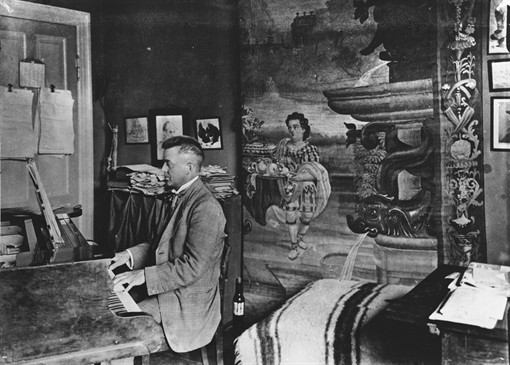
The room where Nielsen composed his 3rd Symphony
After hearing this last movement especially, it’s not hard to imagine why critics proclaimed Nielsen the “Brahms of the North,” even though Brahms would’ve hated most of what he was doing, here. This sense of tonality – which Brahms liked to play with, too, borrowing more from Schubert and his love of “third relations” (going from, say, D Major to F Major rather than G or A Major the way traditionalists might’ve done in Haydn’s day) – which Mahler also used (Mahler died, incidentally, around the time Nielsen completed this symphony) and referred to as “progressive tonality” – is just one of the things that composers were using in order to find “new ways” of handling “old ideas.”

There’s nothing Nielsen does in this work that would leave a listener (even in 1911) at sea – the themes are all memorable, even whistle-able themes. The structure he places them in is easy enough to follow, even if it’s not always traditional, and still, ultimately, satisfying even if you had no idea what he was doing, otherwise.

But he – and others like him – were pulling apart the fabric of the Tonal Scheme that dominated music for over 200 years since the days of Bach, if not earlier.

It was only a matter of time before this fabric would be completely torn apart by three works written around the same time: Claude Debussy’s “Jeux” (summer of 1912), Arnold Schoenberg’s “Pierrot Lunaire” (spring and summer of 1912) and Igor Stravinsky’s “Rite of Spring” (begun in the summer of 1911, but finished in time for its riotous premiere in 1913, one hundred years ago, now).

The Espansiva's premiere in 1911 - which Nielsen himself conducted along with his then-new Violin Concerto - was an immediate success and helped cement his reputation as the leading Danish composer of his generation. If he were the "Brahms of the North," previous popular Danish composers like Niels Gade and Christian Lumbye were on the lighter side, the "Mendelssohn of the North" and the "Johann Strauss of the North," respectively. Nielsen wanted more fiber in the Dane's musical diet, not just sweet pastries.

To him, the last movement of his 3rd Symphony was, as he wrote about it 16 years later, “a hymn to work and the healthy enjoyment of daily life. Not a pathetic celebration of life but a sort of general joy in being able to participate in the business of everyday living and to see activity and skill unfold all around us.”


- Dick Strawser

It's a New Year: Starting off with Wagner & Tchaikovsky

We’ve turned the calendar over to find 2013 has begun and with it, the Harrisburg Symphony’s first Masterworks Concert of the New Year is less than two weeks away.

The soloist is Chee-Yun – you’ve probably heard her recordings on WITF-FM in years past – who’ll be playing the Tchaikovsky Violin Concerto, one of the most popular of all concertos. The program opens with the grand and festive prelude Richard Wagner composed for his opera, Die Meistersinger (“The Mastersinger of Nuremberg”) and concludes with the Third Symphony of the best-known Danish composer, Carl Nielsen, his Sinfonia espansiva.

Stuart Malina conducts the concerts are Saturday, January 12th at 8pm and Sunday, January 13th at 3pm in the Forum in downtown Harrisburg. I’ll be doing the pre-concert talks an hour before both performances, so I hope you’ll come and join us.

Recorded when Stuart previewed the entire season at the Midtown Scholar in September, here’s the part about our up-coming concert.
= = = = =

= = = = =

Richard Wagner: Prelude (or Overture) to Die Meisteringer (“The Mastersingers of Nurenberg”)

Whether it’s called “Prelude” or “Overture” is immaterial – the technical difference is that a prelude leads directly into the action that follows and an overture comes to a stop before the curtain goes up and then the opera begins. Since in the opera house, Wagner proceeds directly into the opening scene without a break, it would be a Prelude, but with a revision to final resolution before that transition begins, Wagner creates a “concert ending” that turns it into a complete piece with a satisfying conclusion. So I guess that makes it, now, an “Overture.” Whatever you call it, it’s the same music and it’s a great piece of music, at that.

It is, as Stuart says, Wagner’s only comic opera – comedy not being something we associate with Wagnerian operas with the stereotype of huge women in breastplates and horned helmets – and it is one of the longest operas in the repertoire, clocking in past six hours with intermission or about 4½ hours of solid music (which is a lot of playing for the orchestra: at least the singers aren’t on the stage singing the whole time). It is also the only opera Wagner composed that’s based on an original story and which doesn’t deal with mythological or supernatural elements – it’s about as “real-life” as many operas ever get: boy meets girl, boy falls in love with girl, boy almost loses girl but wins her in the end (quite literally).

Here’s a performance with Klaus Tenstedt conducting the London Philharmonic on tour in Tokyo (hence the Japanese captions) of the Prelude to Die Meistersinger.
= = = = =

= = = = =

Now, you don’t really need to know all the details of the plot to enjoy the prelude – or overture – except to know the opening theme represents the gathering of the Mastersingers Guild (with a march and then a fanfare which begins at 1:38), a lyrical theme represent the romance between Walter and Eva, a variant of his Prize Song (begins at 4:02), and then a humorous version of the Mastersinger’s March that will be heard when the apprentices make fun of their pompous masters (at 5:14) which Wagner slyly turns into that most academic of old pompous forms, a fugue (at 5:55). Various themes are then heard in various combinations: for instance, at 6:44 to about 7:24, you hear the long-line of the Prize Song theme in the middle strings, the Mastersinger’s Fanfare in the trumpets, their March in the tuba and lower strings, and meanwhile, chuckling along in the background with the violins, the apprentices’ fun version of the Mastersinger’s March. It is amazing how effortless Wagner makes this sound! This continues as the main themes then come back in a glorious conclusion that would make almost any other opera anticlimactic.


Peter Ilyich Tchaikovsky: Violin Concerto in D Major

Chee-Yun, our soloist, has won numerous prizes and made several recordings on the Denon and Naxos labels (you can check out her discography, sample and purchase recordings through this link http://chee-yun.net/audio.html ). She has appeared with major orchestras around the world since winning an Avery Fischer Career Grant in 1990, from the Philadelphia Orchestra and the London Philharmonic to the Hong Kong Philharmonic and many more in between as well as performing in recitals ranging from Kennedy Center to Mostly Mozart.

Here’s a not very good video (I suspect it was recorded off a TV set) but it will give you an idea of her performance. She’s playing Pablo de Sarasate’s Zigeunerweisen (“Gypsy Airs”) at a New Year’s Day concert on Korean television. I’m assuming it’s the Seoul Philharmonic, but this video, like many on YouTube, is uncredited and another video (listed the same way) is clearly a different concert. Neither conductor is acknowledged, but hey – the video is here so you can hear Chee-Yun’s playing.
= = = = =

= = = = =

She’ll be playing a famous concerto that certainly needs no introduction to the audience, but did you know that, at its premiere, it was labeled as “music that stinks in the ear”?

These days, the Tchaikovsky Violin Concerto needs no introduction and the fact that anyone ever could have thought it “stinks in the ear” is amazing to us – one of the great bad reviews usually trotted out to point out the fallibility of critics and defend anyone so viciously attacked in the press (not that they write reviews like that anymore, anyway).

In fact, the author of that review, Eduard Hanslick, is sort of the common denominator in this concert: he hated Wagner and usually reserved his best worst comments for his operas (including Meistersinger) but he also had low regard for the Russian composer Tchaikovsky. As a friend of Brahms, Hanslick did more to spark the rivalry between the Conservative and Contemporary factions of the day than anything the composers themselves could do. And Tchaikovsky, though too western for his Russian colleagues known as the Mighty Handful or the Russian Five, was too wildly Russian for the sedate German-speaking conservatives of Vienna.

At the pre-concert talk, I’ll tell you more about this rivalry and the role Hanslick played in the Style Wars of the Late-19th Century between Wagner and Brahms and how this relates to Tchaikovsky (who disliked Brahms’ music as much as Brahms hated his – imagine being poor Mrs. Edvard Grieg sitting between them at a dinner party!)

Here’s a classic recording of Tchaikovsky’s Violin Concerto in D with the legendary David Oistrakh and Gennady Rozhdestvensky conducting the Moscow Philharmonic:
= = = = =

= = = = =

Tchaikovsky wrote the concerto in 1878 originally for a friend of his, Josef (or, in Russian, Iosif) Kotek who was then a student of Josef Joachim, arguably the greatest violinist of his time. Meeting while Tchaikovsky was recuperating in Switzerland following his disastrous marriage, Tchaikovsky and Kotek played through Lalo’s Symphonie espagnole – Tchaikovsky was a fan of French music, especially Bizet’s Carmen – and that sparked ideas for him to write his own concerto for Kotek who, when it was finished, however, refused to play it. The implication was that it was beyond him (no doubt) but he thought it would be badly received and would probably ruin his budding career.

Consequently, Tchaikovsky dedicated it to Leopold Auer (even had the piano reduction printed with the dedication on it) but Auer, though gratified, thought the work unplayable “in its present form.” Whether Auer thought “unplayable” period is a matter of inference: later, whether trying to save face or not, Auer said he was misunderstood: he wanted to make changes in various passages he thought were uncharacteristically written for the violin and his version would make it sound more natural for the instrument. Tchaikovsky refused.

Ironically, Johannes Brahms had gone through a similar experience with the violin concerto he was writing for Joachim who, looking at certain passages, duly made suggestions which Brahms duly ignored. Joachim was enough of a violinist and a close enough friend of Brahms, however, that he went ahead and premiered Brahms’ new concerto on New Year’s Day, 1877, in Vienna.

Tchaikovsky, having finished his concerto the following year, had to find yet another violinist willing to take it on and finally located Adolph Brodsky who agreed to premiere the work in 1881 – in Vienna.

That was when Eduard Hanslick, Brahms’ friend, described how "the violin was not played but beaten black and blue" and how the finale took “us to a brutal and wretched jollity of a Russian holiday. We see plainly the savage vulgar faces, we hear curses, we smell vodka. Friedrich Vischer once observed, speaking of obscene pictures, that they stink to the eye. Tchaikovsky’s Violin Concerto gives us for the first time the hideous notion that there can be music that stinks in the ear.”

!?

Today, of course, it's one of the most frequently performed and recorded concertos in the repertoire. While it's helped make Tchaikovsky a concert-hall favorite, it hasn't done anything (at least, in a positive sense) for Herr Hanslick.

You can read a separate post on the symphony that concludes the program, Carl Nielsen's Espansiva.

-- Dick Strawser

Thursday, November 8, 2012

Catching a Rising Star with Haydn, Tchaikovsky & Shostakovich

This weekend’s concert with the Harrisburg Symphony includes a young soloist, Julia Rosenbaum, who may not be a familiar name to you. She won the most recent Rodney and Lorna Sawatsky Rising Stars Concerto Competition held at Messiah College, and who, now 16, will play Tchaikovsky’s “Variations on a Rococo Theme” with Stuart Malina and the orchestra – Saturday night at 8pm and Sunday afternoon at 3pm at the Forum in downtown Harrisburg.

(Messiah College teacher and conductor Timothy Dixon will be giving the pre-concert talks an hour before each performance.)

Also on the program are two symphonies: one of the dozen “London” Symphonies by Franz Josef Haydn from 1794 – the 102nd of his 104 symphonies – and the 6th by Dmitri Shostakovich, written in 1939, in the dark months before the start of World War II.

*** ***** ******** ***** ***

Julia Rosenbaum is a sixteen year old cellist currently studying with David Hardy, principal cellist of the National Symphony and professor at the Peabody Conservatory of Music. At the age of twelve, Julia was the youngest Co-Assistant Principal of the American Youth Philharmonic. Julia currently participates in the National Symphony Orchestra Youth Fellowship Program at the Kennedy Center. She is an active performer as a soloist and in chamber ensembles.

Julia was the Grand Prize Winner of the 2012 Rodney and Lorna Sawatsky Rising Stars Concerto Competition at Messiah College, and will be appearing at the Market Square Concerts in Harrisburg, Pennsylvania, performing one of Benjamin Britten’s Suites for Solo Cello.

Julia won First Prize at the Levine School Chamber Music Competition, with performances at the Bulgarian Embassy and the Kennedy Center Millennium Stage.

She was also a prize winner at the Friday Morning Music Club High School Competition for Strings, Washington Performing Arts Society’s Joseph and Goldie Feder Memorial Competition, Young Soloist Recital Series Audition at the Alden Theater, and Asian American Music Society Competition. As the Third prize winner of the 2009 Landon Symphonette Competition, Julia made her concerto debut with the Symphonette.

Julia has participated in master classes by Carter Brey, Lawrence Lesser, Colin Carr, Steven Doane, Hans Jorgen Jensen, and David Finckel and Larry Dutton of the Emerson String Quartet.

Julia has attended the Young Artists Program of the National Arts Centre in Ottawa, Bowdoin International Music Festival, Yellow Barn Young Artist Program, Aspen Music Festival, and Music at Menlo.

Julia is active in performing at assisted living homes, and also enjoys playing with her Siberian Husky, Sable.

You can read Ellen Hughes' interview with Julia and with Stuart Malina in her Patriot-News column Art & Soul, here.

*** ***** ******** ***** ***

If “classical music” is the generic term for the works of Bach, Beethoven and Brahms and their colleagues, “Classical music” with the upper-case ‘C’ refers to a stylistic era of music from the late 18th Century and the time of Haydn and Mozart (and most concert-goers would have trouble thinking of any other equally familiar names from the period – except “Early Beethoven”).

There is also “Romantic music” to refer generically to the music of the 19th Century but we also talk about the essential style of music as being either “romantic” – appealing to the emotions – or “classical” – appealing to the intellect. Before, they used terms like “Dionysian” and “Apollonian” to refer to music that is based on either emotional issues or intellectual ones: Apollo was the Greek god of logic and therefore of architecture but he can also be applied to the clean-lined structures and textures, the “Art for Art’s Sake” we hear in most of this late-18th Century music. Dionysus was the Greek god of… well, wine which of course leads to irrational thinking and the emotional, messy side of life.

In more recent times, we’d think of the brain being divided into two different, often conflicting spheres: the Right Brain and the Left Brain. You can, in your daily life, be a little bit of both (it would be rare someone is all one or the other). If you like mathematics and like a picture because of the way it’s put together, you are having a left-brained response. If you like action movies for their excitement and think a painting is pretty but might not really know what it’s about, then you’re having a right-brained response. If you read mysteries for the enjoyment, that would be “romantic” but if you enjoy them more because of the way they’re put together, how the plot is structured, how everything points you to the conclusion – that would be “classical.”

So in that sense, this concert is about “classical” classical music opening with a symphony by a Classical composer – Franz Josef Haydn, the “father” of the symphony and one of the most acclaimed composers of his time.

Here is Adam Fischer conducting the Austro-Hungarian Haydn Orchestra, part of the series recorded in the music hall of the Esterházy Palace where Haydn spent much of his career writing symphonies and operas for the prince’s entertainment.

= = = = = =

= = = = = =

By the way, it is sometimes known as “The Miracle” Symphony because, after its first performance in London, a large chandelier fell from the ceiling. But because the audience had already rushed forward toward the stage to cheer the composer at the conclusion, no one was injured and everybody said, of course, “it was a miracle!” However, it was believed this had happened at the premiere of the Symphony No. 96 which has then always been officially nicknamed “The Miracle” Symphony. Two different symphonies but the same miracle.

Regardless, it is one of Haydn’s great symphonies but unfortunately often overshadowed by those even greater (or more popular) ones from this set of twelve he composed for London in the 1790s like No. 94 (“The Surprise”), No. 100 ("The Military"), No. 101 ("The Clock"), No. 103 ("The Drumroll") or the last of them, No. 104 (itself known as “The London” Symphony). Perhaps part of No. 102's problem is, it was never given a catchy nickname...

*** ***** ******** ***** ***

The concert continues with one the great Romantic composers – Peter Ilich Tchaikovsky – whose symphonies and ballets seem all to be about the senses with its intense (some might call it maudlin, especially in his last symphony, the Pathetique) heart-on-the-sleeve emotions.

Yet Tchaikovsky was a big fan of Mozart – he orchestrated four of his favorite works by Mozart into his Suite #4 known as “Mozartiana” (this was from a time when not much Mozart was being heard in the concert halls and, of course, there were no recordings or radio broadcasts to acquaint people with his music). Tchaikovsky, as a child, was introduced to music through Mozart and that sense of magic and wonder never left him, even though his own style (sometimes called “hyper-romantic”) is far removed from Mozart’s ideal.

The generation before Mozart and Haydn was a period of transition from the florid textures of the Baroque. Even Bach’s four composing sons, while Johann Sebastian was still alive, no longer wrote in their father’s style (in fact, they jokingly called him “The Old Pig-Tail”) but in a more linear style with simpler textures and a distinct role between melody and accompaniment (unlike the old Baroque style of independent lines moving against each other in what we call “counterpoint”).

For lack of anything better, this style was called “Rococo,” borrowed from art and architecture where it was considered decorative rather than practical and often light-hearted rather than serious: paintings of shepherds wooing their shepherdesses or of well-dressed courtiers having a picnic under the trees. If it had any function – furniture, for instance – it was meant to be pleasing to the eye. And the paintings, the books as well as the music was intended to entertain rather than provide substance for intellectual meditation.

It was an odd mixture of different aspects of what had been the Baroque and what would become the classical.

So it was this element of gracious, graceful and gratifying music that Tchaikovsky decided to capture in his “Variations of a Rococo Theme” – the style of the era captured through his own.

His next major works would be the Violin Concerto which Chee-Yun will perform with the Harrisburg Symphony in January, 2013, and the Symphony No. 4 - so a productive time, musically, for Tchaikovsky!

Here’s a performance with another prize-winner, cellist Gustav Rivinius, recorded with the Moscow Philharmonic conducted by Dmitri Kitaenko, after he won the gold medal at the 1990 Tchaikovsky Competition.

= = = = = = =


= = = = = = =

Of course, to those of who know the music of Mozart and Haydn, Tchaikovsky’s music will still sound lush and Romantic in that 19th Century sense, but it’s a far cry from the impassioned emotionalism of his symphonies (especially the last three) and, for instance, the famous 1st Piano Concerto (for those who do not know his first three symphonies or his other two piano concertos, it would be interesting to check them out, for comparison’s sake).

*** ***** ******** ***** ***

And then we come to Dmitri Shostakovich, a clearly 20th Century composer who was writing large-scale symphonies in the Soviet Union.

If there are people that might have different, often contrasting and sometimes conflicting sides to their personalities (the way they respond to different things in their lives), we might throw around inappropriate terms like “multiple personalities” or even “schizophrenia” (the concept of one person but different identities). Robert Schumann, we heard at the last concert, was an artist who often talked and wrote in terms of the emotional and the logical viewpoints – even to creating characters like Florestan and Eusebius who would hold their own discussions (in the manner of Plato’s dialogues) when Schumann wrote about music (his bi-polar or manic-depressive disorder was something else, again).

Shostakovich had two sides to his music and, though a very private person, to himself though we rarely got the chance to see the lighter side of his personality, a shy man who always seemed nervous in public and rarely seemed to smile.

Shostakovich (front, right) enjoying a game of football, 1940s

If “classical” music is the opposite of “popular” music – as a high school teacher I knew years ago defined it, “classical music is the kind of music nobody likes” which was only a little worse than saying it was “unpopular” music – Shostakovich had his classical side and his popular side, writing serious symphonies and brooding string quartets while delighting in jazz (more accurately, English dance-hall popular music which passed for ‘jazz’ in Soviet Russia) and famously turned out a delightful arrangement of the pop song, “Tea for Two” in less than an hour, a direct challenge from a conductor friend of his. He wrote blistering operas like “Lady Macbeth of the Mtsensk District” and “The Nose” but rollicking stage works like “Moscow Cheryomuzhski” that would be the equivalent of a Broadway show. His symphonies could contain vast movements of nearly paralyzing grief and yet he could conclude his 2nd Piano Concerto with a romp of a finale, written for his son Maxim to play as a gifted young student, which includes a take-off on the English song, “What do we do with a drunken sailor?”

The 6th Symphony, out of context, is a single work that is both serious and popular, and this has often been a problem for its listeners. The first movement is slow, dark, brooding and quite long. The last two movements are both fast, both short and extremely extroverted, especially the finale which is an out-and-out gallop.

If you remember Shostakovich’s violin concerto from last season with Karen Gomyo, you heard dark, almost static movements along with starkly contrasting, fiery, dance-like movements with wild, driving rhythms. Hearing them intertwined like this is like switching back and forth from the light side to the dark side of the moon, two different worlds.

In the 6th Symphony, there is little in its opening dark side that seems to prepare you for the brilliant light side of the last two movements, especially considering the second and third movements combined are shorter than the first movement. The proportions seem wrong. The implications of that opening movement’s tragedy are not resolved in the next two movements but sound like they’re ignored, swept under the rug of popular enthusiasm and sheer entertainment.

The opening movement could be described as romantic music in its emotional content and the last two might be considered the 20th Century’s version of “music meant to entertain,” like the Rococo music of an earlier era but decidedly more down to earth than you’d expect for people wearing satin gowns and waistcoats with powdered wigs. (This is, after all, the far more egalitarian Soviet Union in an entirely different century!)

There may be more than just music, though, behind this seeming stylistic dichotomy: the symphony was created during a time of intense uncertainty in the composer’s life and I’ll write more about that in this further post which you can read before or after the performance with the Harrisburg Symphony this weekend.

Incidentally, Shostakovich was practical and a professional. He wrote music for over thirty films, including eight of them between this 1936 denunciation and his 6th Symphony's premiere, including this one for a children's cartoon called "The Silly Little Mouse," a far cry from the serious symphonist we normally think of!

Here is a recording of his 6th Symphony with Mstislav Rostropovich who as a young man studied with Shostakovich during World War II and later worked with him as a performer of many of his works: both of Shostakovich’s cello concertos were composed for Rostropovich.

(I’m not sure which recording this is, since it’s not included in this post’s information, but I’m guessing it’s with the National Symphony Orchestra in Washington D.C. where Rostropovich was the music director 1977 to 1994.)

= = = = = = =

= = = = = = = =

You can read more background information about the 5th and 6th Symphonies in this post at my other blog, Thoughts on a Train. It includes a hilarious (or depressing, I'm not sure which) anecdote about a special performance of the 5th for the edification of Soviet bureaucrats to determine whether or not his symphony lived up to its excessive success!

- Dick Strawser


Monday, October 1, 2012

Schumann's Rhine Journey

The opening concert of the season is this weekend – Saturday at 8pm and Sunday at 3pm at the Forum – with the Harrisburg Symphony and Stuart Malina opening the program with Richard Strauss’ Don Juan and ending with Schumann’s “Rhenish” Symphony. In between, Israeli pianist Alon Goldstein plays Rachmaninoff's Rhapsody on a Theme of Paganini.

For some reason, Schumann's "Rhenish" hasn't been played by the Harrisburg Symphony since George King Raudenbush, the orchestra's first music director, conducted it in May of 1944. Considering it's regarded as the best of Schumann's four completed symphonies, you have to wonder what took it so long to return?

Robert Schumann’s Third Symphony may have been inspired by a trip on the Rhine River but it doesn’t really tell a story. It’s inspired more by Beethoven’s “Pastoral” Symphony with its “Pleasant Impressions Upon Arriving in the Countryside” and even Beethoven implies more of a program or story behind the music than Schumann does. He uses no titles like “Happy Gathering of Country Folk” though his second movement is based on a folk-dance rhythm. Like Beethoven, he uses five instead of the usual four movements and the added movement – in 4th place (in Beethoven, it’s the storm) – is the only one where Schumann said anything about its inspiration: while visiting the city of Cologne, they were impressed by its great cathedral and witnessed the installation of its cardinal archbishop there with all its pomp and solemnity. (See below for some information about Germany's Rhineland.)

Here’s a performance of the complete Symphony No. 3 in E-flat Major by Robert Schumann, the “Rhenish” Symphony with David Zinman conducting the Zurich Tonhalle Orchestra.

= = = = = = =

= = = = = = =

There's a typical Schumann finger-print in that opening theme which has a kind of rhythmic swing to it that shifts from one pulse to another pulse as the phrase progresses. What we hear - what we would automatically start tapping our foot to - is not always what's written on the page and Schumann tricks us into thinking we're hearing something in a slower three-beat pulse (starting at 0:30)  that suddenly changes (at 0:36) to a quicker pulse - or at least doesn't seem to fit what our toe's already started tapping. He does this quite often in and out of this theme.

Technically, he's using a common denominator of 3/4 time or meter (like a waltz as opposed to a march) but the melody is phrased rhythmically so it accents every other beat so that it takes 2 measures of "written time" to equal 1 measure of "heard time" (putting it in non-technical terms). Like this, where the pink highlighter is the beat pattern you hear, superimposed over the written time that keeps the musicians playing together.


So what Schumann writes in the first 6 measures only sounds like 3 measures in this "slower" beat pattern that our toe starts tapping. Then it shifts (at measure 7) to the "quicker"-sounding pulse which turns out to be the actual 3/4 meter of the music - and affecting how we perceive the music's tempo. There are also other subtle rhythmic ideas that help blur the distinction so we keep shifting back and forth from "perceived" time to "actual" time quite easily.

While this is (technically) more a metrical trick than a rhythmic trick, the even more technical term is "hemiola" (hee-mee-OH-luh) which has nothing to do with a blood disorder but refers to the ability to subdivide rhythmic or metric units into groups of 2s or 3s.

On a different note, think the song "America" from Bernstein's West Side Story as an example:

It alternates between 6/8 and 3/4 where 6/8 divides 6 eighth notes into 2 pulses of 3 eighth notes and then 3/4 which divides 6 eighth notes into 3 pulses of 2 eighth notes: 1-2-3  1-2-3/ 1-2 1-2 1-2 / It's still hemiola even though the style is very different.

Dvořák uses similar tricks in his Slavonic Dances, inspired by the folk-dances of his native Bohemia.

*** ***** ******** ***** ***

Schumann wrote four symphonies but technically his Symphony No. 3 is the last symphony he composed. Probably inspired by its success, he went back and revised what had been his second symphony written ten years earlier (and which he never published) - he didn’t care for after it had been performed and set it aside. So in 1851, it officially became his Fourth Symphony.

It’s kind of a trick question: why is Schumann’s Third Symphony not his third symphony?

A bridge in Düsseldorf overlooking the Rhine
In 1850, Robert Schumann – who’d been living in Dresden since 1844 – accepted a job as the music director of the city of Düsseldorf, a not very exciting city on the Rhine, considered a backward provincial place compared to Dresden and Leipzig, much less Vienna, but it was home to an important music festival where his responsibilities would include conducting the city’s orchestra and choral society. Though on their payroll since early May, the Schumanns didn’t arrive until late August.

The arrival was well-received but it was a short-lived honeymoon.

Cologne's Cathedral
At the end of September, the Schumanns travelled to Cologne and were greatly impressed by its magnificent cathedral where they witnessed the installation of its new cardinal archbishop. Returning to Düsseldorf, Schumann suddenly felt like composing again and on October 10th began the Cello Concerto which he sketched over the next six days and completed (in full score) on the 24th, the same day he conducted his first concert as the city’s music director.

His wife, Clara, regarded as one of the greatest pianists of the day, was the soloist (I haven’t found any indication what was on the program). It was well-received but at the reception afterward there was an awkward moment when Ferdinand Hiller, the previous music director proposed a toast first to the soloist (perhaps being chivalrous) rather than to their new music director. This angered Robert who was always sensitive about being "Mr. Clara Schumann."

Nonetheless, nine days later, Schumann began sketching a new symphony, finishing the sketch of the first movement (despite taking another trip to Cologne) on November 9th and completing the full score of the entire symphony on December 9th.

During his first season there, Schumann conducted eight subscription concerts and premiered five new works of his on four of the programs. The symphony was first heard on February 6th, 1851.

The results were mixed, “ranging from praise without qualification to bewilderment,” though other accounts mention members of the audience applauding between every movement, and especially at the end of the work when the orchestra joined them in congratulating Schumann by shouting “hurrah!”

Geographically Speaking:

Robert Schumann’s Third Symphony is subtitled “Rhenish,” meaning “of the Rhine,” that region of western Germany along the great river associated with so much Germanic history. It rises in the Swiss mountains and flows eventually northeast into the North Sea in the Netherlands. Along its course, it forms Germany’s present-day boundaries with Switzerland and France. In ancient days, it formed (along with the Danube which flows east toward the Black Sea) the northern limits of the Roman Empire. It became a major transportation route during the Middle Ages and one of the most significant aspects of what defined German Culture (at a time when, quite often, there was no political entity called “Germany”). Following the dissolution of the medieval Holy Roman Empire, finally, in 1806, courtesy of Napoleon, a collection of small German states was called “The Confederation of the Rhine” as opposed to larger states like the kingdoms of Prussia, Bavaria and Saxony – or, for that matter, Austria or Österreich, which in German is “Eastern Kingdom” (not that the area along the Rhine ever became Westria…).

The region it flows through once both banks are located in Germany is generally called “The Rhineland” and many important German cities are located here, having grown up as river ports during the medieval era a thousand years ago. From the Swiss border to the town of Bingen (famous for its 12th Century abbess, Hildegard of Bingen), the Rhine is known as the Upper Rhine. Heading north, the region between Bingen and Bonn (famous for its native son, Ludwig van Beethoven) is called the Middle Rhine. Then, though you’re looking at the map and seeing it in the northern region of the river’s course, it’s called the Lower Rhine.

Because the river basically flows north, by going downstream (down the river) you’re heading north which, as you look at the map, makes you think you’re going “up” the river… well, anyway, enough of that.

In Dresden, one of the great Saxon cities (and located on another famous river, the Moldau), Richard Wagner had finished Lohengrin in 1849 just before all that nastiness began with the May uprising after which he was cited for treason and forced to flee “Germany” for Switzerland. But the year before, he began sketching a new opera which, when he realized it would need several prequels to explain, eventually became a four-opera cycle called The Ring of the Nibelung which takes place along the Rhine and actually begins IN it, with the famous water-sprites, the Rhine Maidens, swimming around singing about the Rhinegold and its magic powers. And of course, near the beginning of the last opera, the hero Siegfried makes a famous Rhine Journey of his own which sets the drama on its final collision course.

A Matter of Health: Life after the “Rhenish”

In the long list of great composers who have suffered greatly during their lives, many of them dying young (Schubert at 31, Mozart at 35, Mendelssohn at 38 just a few years before Schumann wrote the “Rhenish”), Robert Schumann’s mental health was his cross to bear. Symptoms of what would now be called bipolar disorder (previously called “manic-depressive disorder”) appeared early in his life but many of these ‘manifestations’ might only be the artistic expression of the two natures of creativity: on the one hand, there’s the “romantic” spirit which focuses on the emotional side of our responses to art; on the other, there’s the “classical” spirit which deals more with the abstract craft and our intellectual response to art. We can all do this – look at a painting and admire it for its architectural structure and placement of material while responding to it on a purely emotional level.

His creative history is a perfect example of “manic-depression.” He would compose furiously for a period of time, focusing on songs on year, or chamber music another, writing furiously and completing sizable works in a few days or a week before going on to another. Then, at the end of this creative spurt, he would be exhausted and suffer symptoms of depression that made him difficult to deal with as it was difficult for him to deal with reality. When they arrived in Dresden in 1844, he was unable to sleep for nearly a week, spent much of his time “swimming in tears” and often unable to walk. The convalescence was slow but six months later he wrote what became the last two movements of the Piano Concerto.

When Schumann was studying to become a concert pianist with the father of the woman who would eventually become his wife, Clara – that in itself is a long story – he injured his hand with a mechanical device that was supposed to facilitate his technique but instead ruined it. This forced him to concentrate on becoming a composer and also a music journalist (not just a critic). In his writings, he often engaged two “guests” who – like the old Greek dialogues – might argue or at least describe the different viewpoints one might have to the same topic. Among these were Florestan (representing Schumann’s “passionate, voluble side”) and Eusebius (his “dreamy, introspective side”) along with others as needed. Whether this is sign of “schizophrenia” as some modern writers assume or not, it seems unlikely they were any different from an author who creates literary characters of different and often opposing natures who might contain some autobiographical details confusing anyone incapable of understanding the distance that exists between a creator and his creations – or, sometimes, doesn’t.

After I’d given a talk about Clara Schumann’s life as a concert pianist and composer dealing with her famous husband and his career in addition to being the mother of eight children (a son was born the year before they arrived in Düsseldorf and a daughter was born the year after their arrival – there was also a miscarriage a year later), a woman came up to me and thanked me for giving her some insight in Schumann’s history. She too suffered from “bi-polar disorder” but was able to keep it under control with medication. We wondered what it might have been like if Schumann had had access to the kind of treatment she had – or what her life would’ve been like without it – which of course is the same kind of speculation about what Beethoven’s music might have been like if he weren’t deaf or what another forty-three years of music from Mozart might have been like if he’d lived to be as old as his sister.

Life in Düsseldorf went downhill quickly for the Schumanns. If the “Rhenish” Symphony’s premiere had met with some success, the next concert was a failure – the chorus sang badly, two new, smaller works were coldly received, and there were growing concerns about Schumann’s abilities as a conductor.

One thing, certainly, was his introspective nature or introverted personality making it difficult for him to deal with musicians in an authoritative capacity. He did not have the power of personality or the technique of a master to impress his performers and keep them in line. Schumann’s predecessor, Ferdinand Hiller, had been a detail-oriented, disciplined conductor, something Schumann was not. He often found himself getting lost during a rehearsal because he would start thinking how better certain passages could be written, for instance. Judging from contemporaries said of him, it’s quite possible he might have been an adequate conductor but didn’t know how to rehearse, a very important aspect of being a conductor (it’s not all just waving your arms around to keep everybody in tempo).

Since Robert could no longer play the piano, he brought Clara in to accompany the choir’s rehearsals and she often found herself explaining to the musicians what her husband was trying to do, musically.

It was in the years after the “Rhenish,” then, that Schumann’s final symptoms took control of his life. Whether he was depressed following the year-long manic creative spell that the symphony inaugurated or whether it was the political in-fighting that started to go on between the musicians in the orchestra and chorus, their boards, and the Schumanns is almost immaterial. He began having auditory hallucinations, spending long hours staring into space, exhibited fears of things like keys and so forth. Clara, of course, was working hard to protect her husband from the problems around him which others didn’t seem to understand.

On September 30th, 1853, Clara, long despairing of resuming her old career as a concert pianist sacrificing herself for her husband, wrote in her journal, "My last good years are passing, my strength, too... I am more discouraged than I can possibly say." Robert wrote in his journal, "Herr Brahms from Hamburg," mentioning a 20-year-old composer who showed up on their doorstep, unexpectedly, with a bunch of scores to show him. But at the time Brahms arrived, the Schumanns weren’t at home so the actual meeting, hearing Brahms play some of his piano pieces, didn’t happen till the next day.

Schumann hailed Brahms as the “heir to Beethoven,” not the first young composer saddled with such a comment, but he did not have much time to serve as Brahms’ mentor.

Brahms stayed in Düsseldorf until early November. A few days after he left, a committee from the orchestra arrived at the Schumanns’ house announcing that they were going to curtail Robert’s duties: he would no longer conduct the choir and he would only conduct his own works with the orchestra, his responsibilities now being taken over his assistant, Julius Tausch.

What had been a good month during Brahms’ visit quickly soured.

On February 27th, 1854, Robert Schumann, who was so ill, his condition so worrisome at the time he had to be locked in and watched every minute, got away from his daughter who was supposed to keep an eye on him, and wandered the streets of Düsseldorf before coming to a bridge over the Rhine where he jumped into the river. Some passing people and some boatmen were able to rescue him and take him back to the house where he was immediately taken by carriage to an insane asylum near Bonn. Clara never saw him again until a few days before he died in 1856.

It’s more likely the symptoms of the illness that caused his insanity and lead to his death were the results of an early infection with syphilis and the mercury treatment that was supposed to cure it but often was just as much a killer. Whether this had anything to do with his manic/depression or bipolar disorder is another issue.

Regardless, we should be glad for the brilliant moments he experienced and was able to share with us through his music. It is quite a journey.

- Dick Strawser

*** ***** ******** ***** ***

You can read more about the final years of Robert Schumann’s life and about the life of Clara Schumann in posts at my other blog, Thoughts on a Train.

Saturday, September 29, 2012

Rachmaninoff's Rhapsody: Setting the Scene

Rachmaninoff
The first concert of the Harrisburg Symphony’s new season - Saturday, October 6th at 8pm, and Sunday, October 7th at 3pm at the Forum in Harrisburg - includes one of the most popular works for piano and orchestra that isn’t a piano concerto – Sergei Rachmaninoff’s Rhapsody on a Theme of Paganini. Another one is Gershwin’s Rhapsody in Blue but the fact that they’re also both called “rhapsodies” might seem misleading.

While Gershwin’s is definitely rhapsodic (“rhapsody” was a generic term for something that didn’t quite fit any other named kind of form like “sonata” or “minuet with trio”… but which didn’t have a story to tell like Schumann’s “Carnaval” or Dukas’ The Sorcerer’s Apprentice), Rachmaninoff’s is not only very much like a concerto in three or four movements (without any real breaks, like Franz Liszt’s concertos) especially given the demands on the soloist, it’s actually a set of variations. But then, Rachmaninoff the composer could call it anything he wanted to…

Rachmaninoff based his variations on the last of Nicolo Paginini’s 24 Caprices for solo violin which is, in itself, already a set of variations on his own, simple theme. In fact, this theme was so fertile, it inspired many other composers to write their own variations on it – Brahms for one, Witold Lutoslawski more recently.

Despite being very popular, it’s difficult to find a complete – and good – performance on YouTube, so here’s one – Rachmaninoff himself playing it with the Philadelphia Orchestra conducted by Leopold Stokowski and recording right after the world premiere in 1934. As historic recordings go, this YouTube poster admits to manipulating the audio (‘quasi-stereo’ &c) to make it sound less scratchy as an old monaural recording taken off old 78s (for those of you who consider CDs passe, it would take too long to describe this…).

= = = = = = =

= = = = = = =

Paganini’s theme is heard in a bare-bones presentation just ten seconds after the introduction, first with the harmonic skeleton then the theme brought in at 0:30 to flesh out what now appears to have been the accompaniment. This goes through a great deal of “stormy and stressful” expansion before he introduces something new at 5:29 – but it’s a theme he’s often used in many of his works and its frequent presence makes one wonder about its significance for him.

This is the ancient Gregorian chant, the Dies irae (dee’-ace ee’-ray) from the Roman Catholic Mass for the Dead – the Day of Wrath, Judgment Day. It creates the most dramatic (and often terrifying) moments of great settings of the Requiem Mass – think Mozart and Verdi. It becomes a kind of death’s-head theme peering out from the most sinister moments of Berlioz’s Symphonie fantastique or that staple of the Hallowe’en concerts repertoire, Franz Liszt’s Todentanz, the “Dance of Death” for piano and orchestra.

Still, what it’s doing here is conjectural, since Rachmaninoff never explained why he used here, much less anywhere else that I’m aware of. But it fits the back-story with Paganini who, legend has it, sold his soul to the Devil in order to be able to play like he did. And many people believed it – in fact, the Church even refused to allow his burial in consecrated ground! (You can read a fanciful account of meeting Paganini in the afterworld where he – eventually but quite accurately – describes his post-mortal experience over at my collection of short stories, Stravinsky's Tavern…)

The appearance of the Dies irae gives the theme a sinister back-drop, often overlapping with the theme (see 7:31) which actually makes it a “double” set of variations – two themes for the price of one. Wisps of the Dies irae can often be heard lurking in the accompaniment or perhaps fragments of it imbedded into Paganini’s theme.

This will eventually give way to a quieter, more lyrical episode. Finally, after an unsettled and rather vague variation (12:30), the moonlight breaks through the gloom for the famous 18th Variation – starting at 14:15 – the spot where you can probably hear everybody in the audience sigh collectively and lean back comfortably into their seats. This is truly a magical moment and the beauty of the melody is worth its reputation.

Ironically, as new and different as it sounds, it really is only Paganini’s theme slowed down and played upside-down!

This bit of contrast is like a slow movement in a concerto. Soon, we’re back into the dramatic turmoil, perhaps a dance-like scherzo beginning at 16:48. This gradually becomes more and more finale-like, full of virtuosic flourishes worthy of any concerto. It ends, strangely – after one more appearance at 21:40 of the Dies irae -- with a final sly wink rather than the bravura bombast it had been leading up to, what we might expect considering his 2nd and 3rd Concertos.

*** ***** ******** ***** ***

Sergei Rachmaninoff was one of the greatest pianists of the 20th Century as well as a much loved composer. To look at him, even in the photograph (see above) where he’s sitting down, you could imagine why Igor Stravinksy described him as “a six-foot scowl.” Practically every photograph I’ve seen of him – certainly all the “official” or formal ones – evoke the Great Stone Face of Classical Music.

It’s hard to imagine him, given his buzz-cut hair, ever letting his hair down, so to speak. Yet here is a collection of private home-movies showing the composer with his family and friends, particularly with his daughters and his grandchildren. Imagine watching this “six-foot scowl” bouncing across the lawn with his daughter (at 1:35) or playing “Ring Around the Rosey” with his granddaughter (6:50).

= = = = = = =

= = = = = = =

One of the works you can hear in this video compilation is his recording of the "Polka of V.R." (4:00-7:21) based on what he thought was a little dance tune his father, Vassily (the V.R. - or in German/French, W.R. - of the title) would play when he'd come home and his children, quite young then, would dance around the room to it. Not the kind of domestic bliss you'd expect, looking at the standard images of the mature Rachmaninoff, is it? He wrote this in 1911, the day after the world premiere of one of his few religious choral works, the Liturgy of St. John Chrysostom, setting the divine liturgy of the traditional Russian Orthodox church service. (Speaking of contrasts...) It was only long after Rachmaninoff's death that the actual composer of this little polka - Franz Behr - was identified.

Much of the footage you see here was taken at the Swiss villa he built to emulate his old Russian family estate in the mid-1930s. He composed his Rhapsody on a Theme of Paganini there in 1934, so these images of the composer are basically contemporary with the music you're hearing on the orchestra's concert.

*** ***** ******** ***** ***

He was born in Russia to a wealthy land-owning family in 1873 and grew up during the “golden age” of the late-19th Century Russian Empire. But his father’s gambling debts helped ruin the family fortune and they moved from their country estate to the imperial capital of St. Petersburg where Sergei began to pursue his piano lessons more seriously. He eventually also began to exhibit talent as a composer and was something of a triple threat at the Conservatory, studying piano, composition and conducting.

A successful career seemed inevitable and then his first symphony was premiered at the Conservatory. It was a disaster, reviled in the press, and for almost three years, Rachmaninoff was unable to compose a thing. Someone suggested he see a therapist, Nikolai Dahl, who tried hypnosis on him and presumably by telling him “You will write a new piano concerto and it will be wonderful,” Rachmaninoff’s creativity came back to life and, in fact, his 2nd Piano Concerto was more than wonderful.

As I’ve often said, when an orchestra gives a bad performance of Beethoven (or anything well-known), the conductor is blamed but when it’s a new work, it’s the composer’s fault and that’s what happened here. Rachmaninoff withdrew the symphony but never publically blamed Alexander Glazunov, the conductor, who was a known alcoholic and according to witnesses quite drunk at the performance. Glazunov wasted rehearsal time, the orchestra was underprepared and there were two other premieres on the program. But the press had little reason to be quite so savage in their pronouncements: a leading critic (and a lesser composer of Rimsky-Korsakoff’s circle), Cesar Cui, said it would be admired in the Conservatory in Hell and suggested the symphony told the story of the plagues of Egypt. I mean, really… what 24-year-old who’s just finished a 40-minute symphony and who’s expecting to launch a highly anticipated career could have withstood that kind of public drubbing?

(Curiously, since no one would’ve heard the piece again – he’d destroyed the score but someone found a copy of the parts and was able to reconstruct it – he occasionally quoted from it, particularly in what became his very last work, the Symphonic Dances. Rachmaninoff had appended the score with an epigram from Tolstoy’s Anna Karenina, implying there might be a story behind the music, program or no program: “Vengeance is mine, I will repay.” Could that be why, all his life, he was obsessed with the Dies irae theme for the Day of Judgment? Was he, musically, having the last word? Hmmm…)

At any rate, the 2nd Piano Concerto of 1901 finally launched his career. His 3rd Piano Concerto was composed during an ocean crossing and premiered in the United States in 1909, its second performance in New York City with the New York Philharmonic conducted by Gustav Mahler.

Incidentally, the main reason Rachmaninoff decided to make the long trip to America was because the fees were so good there, he could buy a fancy new car. He loved cars. Later, people who would visit him at his homes in America or Switzerland would find him peering under the hood of his latest acquisition, his hands blacks with engine grease.

Meanwhile, the situation in Europe was getting worse – it would only be a matter of time before everything would be ripped apart. In 1914, it finally did, and World War I made traveling in Europe. Then, the old world collapsed in Russia as the Tsar was overthrown and then the provisional government was overthrown by the Bolsheviks.

Rachmaninoff was offered a concert tour of Scandinavia in 1917 and was able to leave the country only weeks after the Bolsheviks toppled the government. Driven on a sleigh from Petersburg to the Finnish border in a snowstorm one night, Rachmaninoff and his family left Russia forever, leaving all their possessions – and most of his manuscripts – behind at the estate that would soon be taken over by the proletariat.

Almost a year later, Rachmaninoff arrived in America for another concert tour, this time trying to make ends meet. Without any income from his music much less his family fortune, Rachmaninoff had to focus on staying alive and so he decided it would be better to be a concert pianist than a composer which took too much time and was, frankly, not as rewarding financially. He was offered a conducting job with the Boston Symphony but refused it.

Anywhere he lived, he tried to recreate his Russian homeland around him. The family and friends who visited saw Russian décor, spoke Russian, ate Russian food, but still Rachmaninoff, when he thought he’d try composing again, couldn’t because, as he explained, he had lost his Russian soul. It’s difficult for us to realize that with the 1917 Revolution, Russia ceased to exist as a country – it was now the Soviet Union, a very different political and social entity – and Rachmaninoff was only one of countless Russian ex-patriots wandering the globe “without a country.” Some, like Stravinsky, adapted to becoming first French then Swiss then American. But for Rachmaninoff, it was almost impossible.

Essentially between 1917 and the end of his life in 1941, he wrote only six original works. He did, however, produce numerous transcriptions – the first one being an arrangement of the Star Spangled Banner in 1918. A transcription of three movements from Bach’s Partita in E for solo violin was given its first performance here in Harrisburg at the Forum in 1934 - only months before he began to compose the Rhapsody on a Theme of Paganini.

This argument may seem over-simplified, given that most of his 2nd Symphony, the tone poem Isle of the Dead (speaking of Dies irae and total gloom) and his 1st Piano Sonata in the German city of Dresden during the winters between 1906 and 1909 when he then began the 3rd Piano Concerto, most of which was written in transit to his American tour that year. But he could spend the summers on his Russian estate and, of course, he knew that he would always return to his native soil.

When he knew he would never return and knew that whatever he might return to wouldn’t be the same, the impact was severe.

Of those few original works he composed after leaving Russia behind, most of them were poorly received. The 4th Piano Concerto never caught on, even after he revised it extensively. It just wasn’t the 2nd or the 3rd. His 3rd Symphony, for that matter – which Stuart Malina and the Harrisburg Symphony performed here a few seasons ago – was dismissed because it wasn’t the 2nd Symphony. The non-Russian Variations on a Theme of Corelli (which was actually an old Spanish dance tune, “La Folia”) had a checkered career, mostly never successful. His Symphonic Dances were panned at the premiere.

Only the Rhapsody on a Theme of Paganini caught the public’s attention.

Why is that?

Given Rachmaninoff’s gift for melody, his brilliance at writing for the piano, his skill at working with the orchestral palette, why only this piece?

How did this, among those few others, survive all the problems the composer had with his fragile creative energy? Given he didn't need to compose to make a living and the trouble it caused him when he tried, not to mention the disappointment much of it was causing him, it's amazing he even bothered to write this piece.

Of course, one might as well ask “what makes a masterpiece?” or “how do you create a hit?” That is one of the many mysteries of the artistic life.

At least we have this one to enjoy.

- Dick Strawser

Thursday, September 27, 2012

The Season Begins: Open with Strauss's 'Don Juan'

A couple weeks ago, Stuart Malina gave a “pre-season preview” for the new 2012-2013 Harrisburg Symphony Season at the Midtown Scholar at 3rd & Broad (a.k.a. Verbeke – basically, across from the old Broad Street Market). Here’s a clip with Stuart talking about the 1st Concert coming up the first weekend in October, at 8pm on Saturday the 6th and at 3pm on Sunday the 7th at the Forum in downtown Harrisburg.

The program opens with Richard Strauss’ tone poem, Don Juan and concludes with Robert Schumann’s Symphony No. 3, the “Rhenish.” In between, Israeli pianist Alon Goldstein performs one of those enduring classics, the Rhapsody on a Theme of Paganini, a set of variations for piano and orchestra by Sergei Rachmaninoff.

= = = = =

= = = = =

Stuart plays an excerpt from the opening of Don Juan from 2:36 to 3:18. (It’s always fun to watch someone listen to music, to catch their reactions: how does a conductor look when he’s listening to something he’s going to be conducting soon?)

Here’s the complete tone poem in the performance with the Berlin Philharmonic conducted by Simon Rattle.

= = = = = = =

= = = = = = =

As Stuart mentions, Strauss wrote this when he was 24 (which is pretty amazing in itself) and while it was his first “big success,” it wasn’t his first work – he’d composed a 33-page overture for full orchestra (which he orchestrated himself) when he was 9 (after a bunch of piano pieces and songs he’d written since he was 6). His first horn concerto, begun when he was 18 and written for his famous horn-playing father, is one of the major works in the horn repertoire today.

R. Strauss at 22
If you attended this past summer’s “Summermusic” series with Market Square Concerts, you heard an early work by Richard Strauss that is not in the repertoire and rarely performed – his Piano Quartet in E-flat Major. You can hear a performance of it at this post in my other blog, Thoughts on a Train, and follow (at the end) the path that led from Richard Strauss child prodigy to Richard Strauss mature artist at 24 with Don Juan.


The work is a “tone poem” (a ‘form’ popularized if not ‘invented’ by Franz Liszt) – a musical composition that tells a story in sound, which can also be called “symphonic poem” or, more generically, “program music” (music that tells a story) – as opposed to a symphony which, normally, is abstract and concerned more with form and development of thematic materials. It depends on the composer or even the specific piece whether it’s an interpretation of the story or a cinematic depiction of it. One of the most famous tone poems, Tchaikovsky’s Romeo and Juliet has different themes associated with characters or moods found in Shakespeare’s tragedy but it does not tell the story in a continuous, dramatic way, though we can hear “love music,” “struggles” and the death of the lovers at the end.

Strauss’ Don Juan is based on the legendary lover (who predated the more-or-less real Cassanova) that also inspired Mozart’s opera Don Giovanni and numerous other works, both musical and literary.

Lenau in 1844
Nikolas Lenau’s version of Don Juan was written in 1844 and is a very different approach to anyone familiar with Mozart’s opera. One can hear heroic music, “love music” as well as dramatic conflict and a tragic conclusion. In this case, Don Juan isn’t dragged off to hell by a chorus of screaming demons. In Lenau’s work, he has been searching for a “feminine ideal” (familiar also to readers of Goethe’s Faust) which he can never find and so goes to his death willingly rather than live an unfulfilling life.

It’s interesting that Lenau also wrote his own version of Faust, very bold for a German-speaking writer considering Goethe, the greatest writer in the German language whose Faust is considered the greatest work in German literature, had died only four years earlier in Weimar. While Lenau had spent a year in America living in a frontier settlement in Ohio in 1832, he tired of Americans and their wilderness and returned to Austria. He wrote many poems and lyrical epics but was dissatisfied with life himself. Shortly after completing Don Juan, he experienced an “episode” where he jumped out a window and ran down the streets (I believe of Vienna) shouting about revolution and fire. He was kept “in restraint” and confined to an asylum near Vienna where he died in 1850. This also has an eerie parallel with Robert Schumann who experienced a similar unfortunate end a few years later.

Richard Strauss at 26
Richard Strauss conducted the world premiere of his Don Juan in November of 1888 and wrote home two days after its first performance and said, "Well then – Don Juan had a great success, it sounded wonderful and went very well. It unleashed a storm of applause rather unusual for Weimar" (a much-revered cultural center in Germany that had been the homes of Goethe and Liszt). It went on to turn him into a sensation, the start of a successful career as both composer and conductor.

Interestingly, the year also saw Gustav Mahler conduct the premiere of his 1st Symphony – a banner year for new music and the beginning of the careers of two of the most influential composers at the end of the 19th and start of the 20th Centuries. Brahms, fresh off the disappointment given to his recent Double Concerto (he destroyed at least one more symphony and another violin concerto as a result) wrote that he was “repulsed” by Strauss’ new tone poems and told the young Mahler (whose conducting he admired, if not his music) that he considered himself the end of the long line of great composers (“after me, the dungheap!”). Well, yeah... the Generation Gap was real long before the '60s.

Anyway, I’ll write about the Rachmaninoff Rhapsody and the Schumann “Rhenish” in later posts, so check back.

- Dick Strawser

Wednesday, September 12, 2012

Stuart Sets the Season

Thursday evening, beginning at 7:00, Stuart Malina presents a preview of the new 2012-2013 Season with the Harrisburg Symphony at the Midtown Scholar Bookstore on 3rd Street across from the Broad Street Market. You can find out more about the symphony's concerts, the soloists and the repertoire they'll be playing. Find out what he's looking forward to - (everything, of course!) - and hear some stories behind the music and why he chose it.

There's on-street parking available (especially around the corner on Verbeke a.k.a. Broad Street) plus free parking in the lot behind the store.

Come early and browse through the books (the music section is on the second level), grab some coffee, find a chair and sit back for an enlightening evening.

Did I mention it's free?

By the way, I love this store - for any number of reasons. Naturally, an old-fashioned bookstore is a treasure, these days, especially when many of the national chains seem to be going out of business. The building used to be an old movie theater -- the music section is in the old projection booth area -- and the ticket kiosk in the center of the front entrance is still used as a display case. More recently, it was a used furniture shop but in the '50s it was 'The Boston Store' where I spent a lot of time as a kid, growing up: my dad, Norm Strawser, was the manager there until around 1970. So walking in there always takes me back, déjà vu all over again...

The book store presents lots of concerts and has earned a great reputation for its "acoustic venue" mostly for singer-songwriters and folk groups. Market Square Concerts had a great presentation a few seasons ago with cellist Zuill Bailey's CD release party where he played some of the  Bach Suites on his Telarc disc and talked about the recording or about growing up playing Bach.

More than just a neighborhood gathering place, the Scholar is also a place for community discussions with panels about the city financial crisis and many other local issues. Numerous community groups meet there, ranging from book clubs to poetry readings to children's programs. One Saturday morning I was browsing around for something about Mahler - found some, too! - and there was a presentation about train safety for kids on the stage that, in the next hour, became an Irish folk group's noon-time concert.

- Dick Strawser